
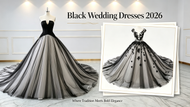
Black Wedding Dress in 2026: Bold Statement or the New Normal?
30th Jul 2026
If you'd told me three years ago that I'd be getting married in a black wedding dress, I would have laughed. Not because I don't love black—honestly, 80% of my closet is some shade of charcoal or obsidian—but because a wedding dress? That felt like a different category entirely.
And yet, here we are.
I didn't set out to write a blog post about this. I was just doom-scrolling wedding content at 2 AM, like you do, and I came across The Knot's 2026 Real Weddings Study. One stat stopped me mid-scroll: more than two-thirds of Gen Z brides are skipping white. And among the brides who go with another color? Black is right behind champagne.
That got me thinking. Not because I needed permission—I'd already decided—but because I wanted to understand what I was actually part of. Turns out, I'm part of a pretty big shift.
The study asked brides why they chose the color they did. Almost 80% said they picked something—black, blush, whatever—because it felt like their story, not someone else's template. That landed for me. Because wedding planning, if I'm honest, can start to feel like you're performing a script that was written before you were born. The dress felt like the one line I got to rewrite.
I braced myself for side-eye from my grandmother. She's the type who thinks "casual Friday" is a moral failing. But here's the part that actually surprised me: the data suggests that most younger relatives—under 55 or so—think black wedding dresses are cool. And even among the older crowd, the people who initially raise an eyebrow? More than 70% come around once they hear the reason behind it.
There's a story making the rounds on wedding forums that stuck with me. A bride's grandmother told her black was "for funerals" until she explained that her fiancé proposed at a midnight jazz club—the same place they'd had their first date. After that, the grandma apparently called it "the most romantic thing she'd ever seen."
That made me tear up, not gonna lie. The older generation isn't impossible. They just need context. A story to hold onto.
If you're actually shopping for a black dress right now, here's what's trending. Not that you have to follow the crowd—but it helps to know what's out there before you step into a bridal shop.
A-Line seems to be the runaway favorite. Fitted bodice, skirt that gently flares out. The soft shape softens the black, makes it feel romantic instead of heavy. Works for pretty much any venue. A lot of designers this year are doing hand-stitched lace overlays on these, which gives them this artisanal, heirloom quality.
Fit-and-Flare is next—fitted through the hips, then flares around the knee. It's body-conscious in the best way. I've seen these look incredible in industrial spaces with exposed brick and metal fixtures. One bride in Brooklyn wore hers with black velvet couches and a neon LOVE sign behind her, and the photos were absolutely killer.
Ballgown is for the brides who want full drama. Lots of volume, tulle, heavy beading. This is the dress if you're doing a Gothic or masquerade theme. There's a bride in Scotland who got married in a 12th-century castle wearing a black ballgown with silver constellations stitched into the skirt—her and her partner's favorite stars. I saw her photos and almost changed my mind about going A-line.
Slip dress is the minimalist route. Sleek silk, thin straps, nothing fussy. Perfect for modern art galleries or all-white venues where the black dress becomes the only punctuation mark in the room. A couple in Tokyo did their entire wedding in a white gallery space—bride in a black silk slip, everything else white. They said it felt pure and intentional. I get that.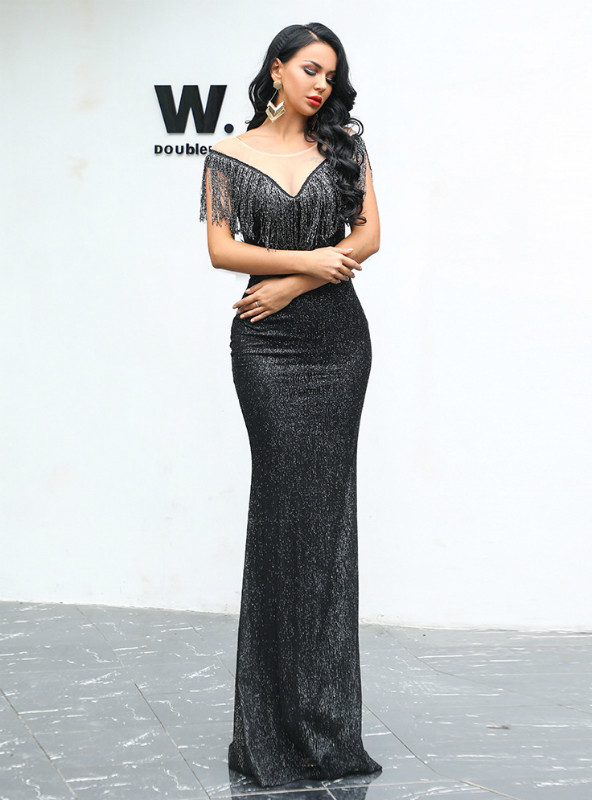
Here's something I've noticed while planning: the dress kind of tells you what the rest of the wedding should look like. Or maybe it's the other way around—you pick the vibe first, and the dress follows.
Either way, here are the pairings that feel most natural for 2026.
Midnight Garden — outdoor wedding after dark. String lights in the trees, black calla lilies and deep burgundy roses, candles everywhere. An A-line black dress blends right in—like a shadow moving through flowers. One bride in Oregon paired hers with black dahlias and baby's breath and called it "getting married in a secret enchanted forest." I mean, come on.
(Picuture from:https://www.rocknrollbride.com/2024/05/ethereal-midnight-garden-party-wedding/)
Industrial Chic — converted warehouses, exposed brick, metal fixtures. Fit-and-flare dresses shine here because the structure echoes the roughness of the space. Black against grays and browns pops more than you'd expect.
Vintage Noir — old Hollywood glam with a moody twist. Black-and-white photo backdrops, velvet furniture, jazz bands. Lace A-lines with red lipstick and pearls. A New Orleans bride described her look as "Casablanca but make it modern," and I'm stealing that line.
Gothic Elegance — castles, historic chapels, candelabras, stained glass. Ballgown territory all the way. That Scotland bride said her wedding wasn't just a wedding—it was a celebration of everything dark and beautiful in their relationship. Heavy, but also kind of perfect.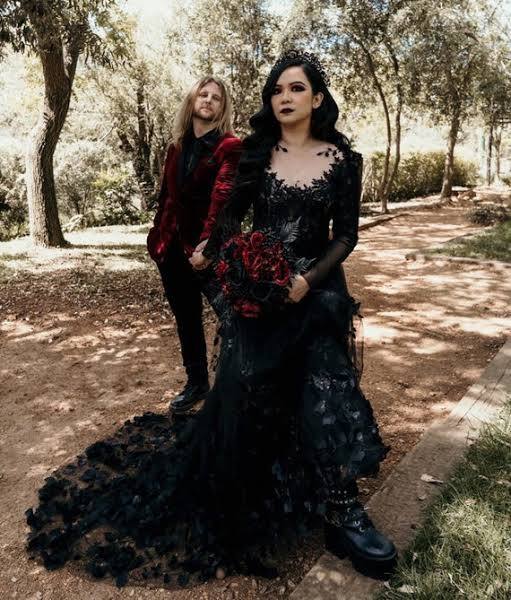
Modern Minimalist — clean white spaces, simple greenery, warm ambient light. Your black slip dress becomes the focal point because there's nothing else to compete with it. The Tokyo couple got it right—less really is more.
I'm not going to pretend family tension isn't a real concern. This was my biggest anxiety going in. My mom is chill about pretty much everything, but my grandmother? She still thinks jeans are for gardening.
But I've seen 2026 brides figure out some genuinely clever workarounds.
One of them is the ceremony-to-reception switch. You add a removable white lace overlay or cape for the actual vows. Your grandparents see what they expect to see during the formal part, and then you whip it off at the reception and reveal the black. It's a small compromise that costs almost nothing emotionally, and it works.
Another is telling your story out loud. Remember that stat about older relatives coming around after hearing the reason? It's real. Don't frame it as rebellion. Frame it as a love story detail. "He proposed at a jazz club." "Our first trip together was a city where we only went out at night." "I wore black the day we first said I love you." Specific beats abstract every time.
And if your mom or grandma is crafty, invite them in. One of my friends had her grandmother—who initially hated the black dress idea—hand-stitch a square from her own childhood quilt into the inside hem. By the wedding day, her grandma was telling everyone about "the black dress with my stitching in it." She went from critic to co-conspirator.
Here's what I keep coming back to.
Choosing a black wedding dress in 2026 doesn't feel like a radical act anymore. It feels like an honest one.
We're the first generation that's looking at wedding traditions and asking, "Wait, who is this actually for?" And if the answer is "everyone except us," we're finally giving ourselves permission to change it.
That bride with the midnight jazz club proposal—she said it best: "My black dress wasn't just what I wore. It was a declaration that our love doesn't fit in a box. And in the end, even my grandma said it was the most 'us' thing I could have done."
I don't know if my grandma will get there. But I think she might. And either way, on my wedding day, I'm going to look down at that black dress and feel like myself.
That's the whole point, isn't it?
Sources Cited:
- The Knot 2026 Real Weddings Study: https://www.theknot.com/content/wedding-data-insights/real-weddings-study
- The Knot Alternative Wedding Dress Ideas: https://www.theknot.com/content/alternative-wedding-dress-ideas
- Zola 2026 Wedding Style Report: https://www.zola.com/expert-advice/2026-wedding-style-report