

The Anatomy of a Garden: Inside the Atelier Craft of a Flower-Beaded Green Ball Gown
26th Aug 2026
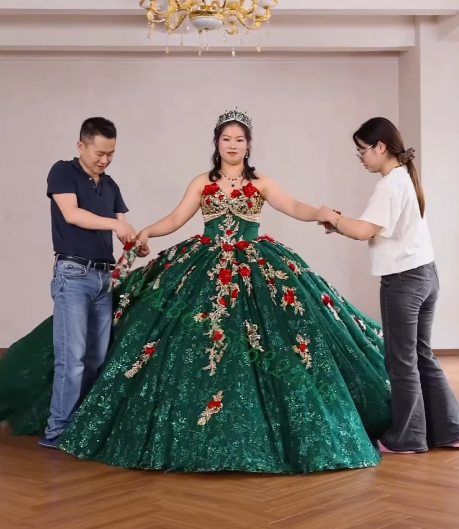
One Green Dress, and the Thousand Decisions Behind It
A closer look at the pattern, corset, hand-cut flowers, fittings, and tiny corrections that turned a sketch into a finished green ball gown.
There is a moment in every atelier when a dress stops being a drawing and starts taking up space.
For this green ball gown, that moment didn't come when the last bead went in. It came much earlier, on a Monday morning, when the muslin toile was pinned to the form, still white, still covered in pencil marks and torn strips of masking tape.
One of the pins near the bust was slightly crooked. The assistant had rushed it. The designer walked around the form twice, stopped, and tapped the waist with his knuckle.
"Take this in another centimeter. Not more. Exactly one."
That was how it started.
Outside the workshop, the marketing team called it the "Garden Gown." Inside, it was just job number SS06. The brief, as the designer put it, was simpler and less poetic:
"Make a dress that ensures the woman wearing it cannot be ignored in any room she walks into."
That philosophy is part of what makes a dramatic green prom dress so compelling. The color does much of the talking. The construction has to make sure the woman wearing it can actually enjoy the attention.
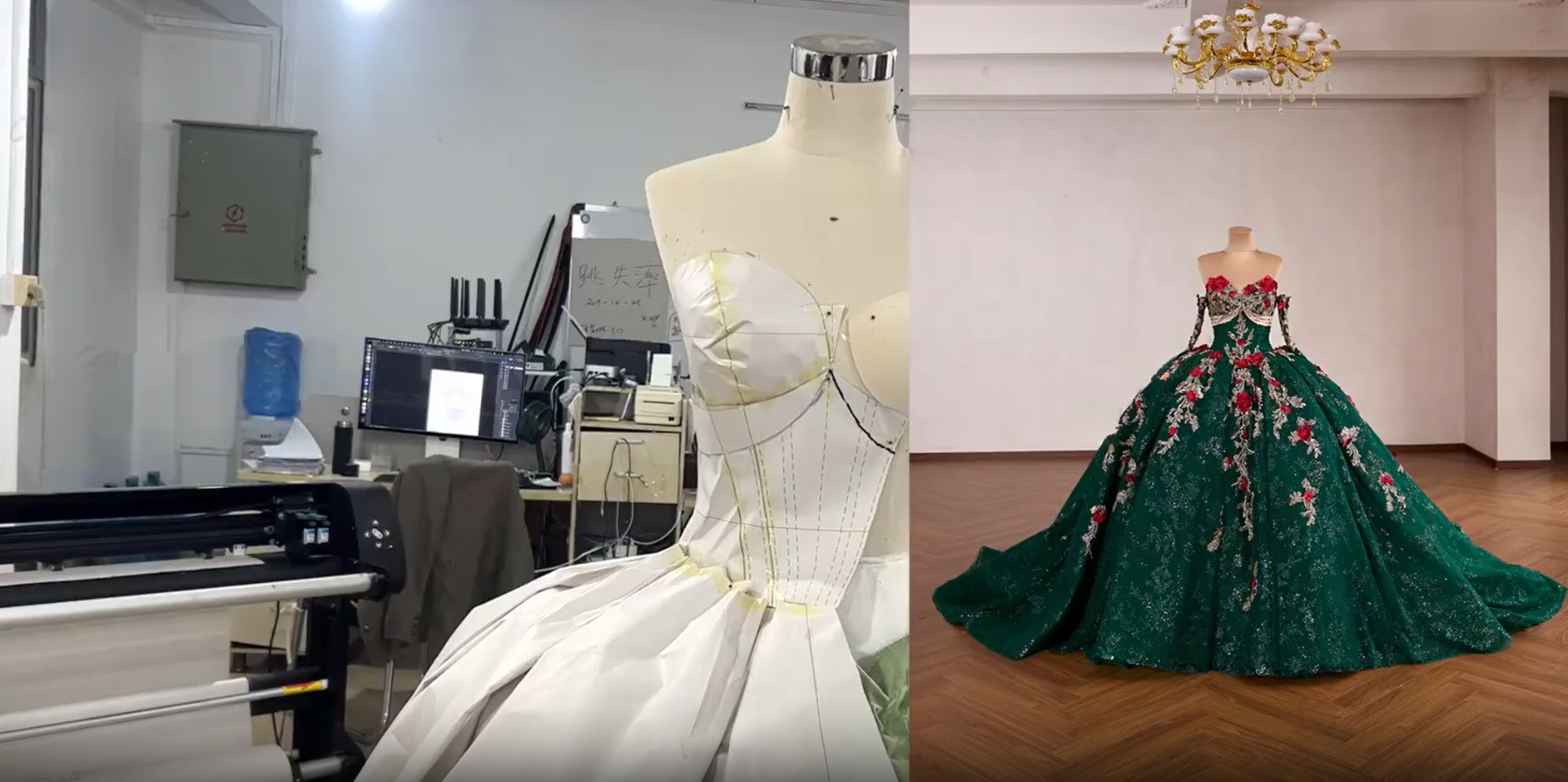
He would step back, squint, walk around the form, then unpin three pins and reposition them.
The skirt's flare alone went through four versions. The first was too wide. The designer said it looked like a costume from Gone with the Wind. The second was too narrow. Timid, he called it.
The fourth one finally worked. When the muslin hung from the waist, the hem traced a clean circle on the floor. Wang grunted, made a small mark with his pencil, and moved on to the bodice.
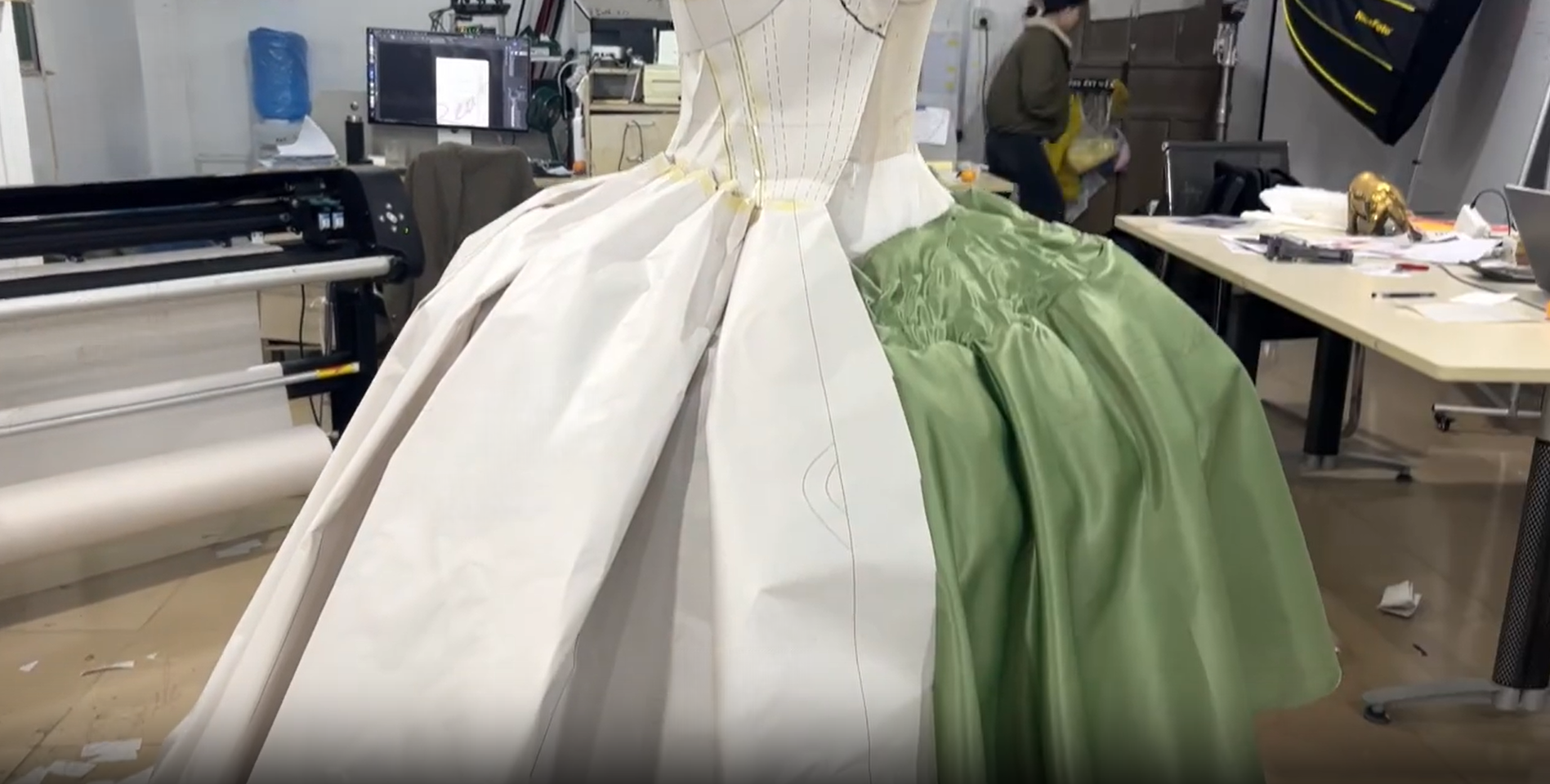
A fitting model made from fabric that can be corrected.
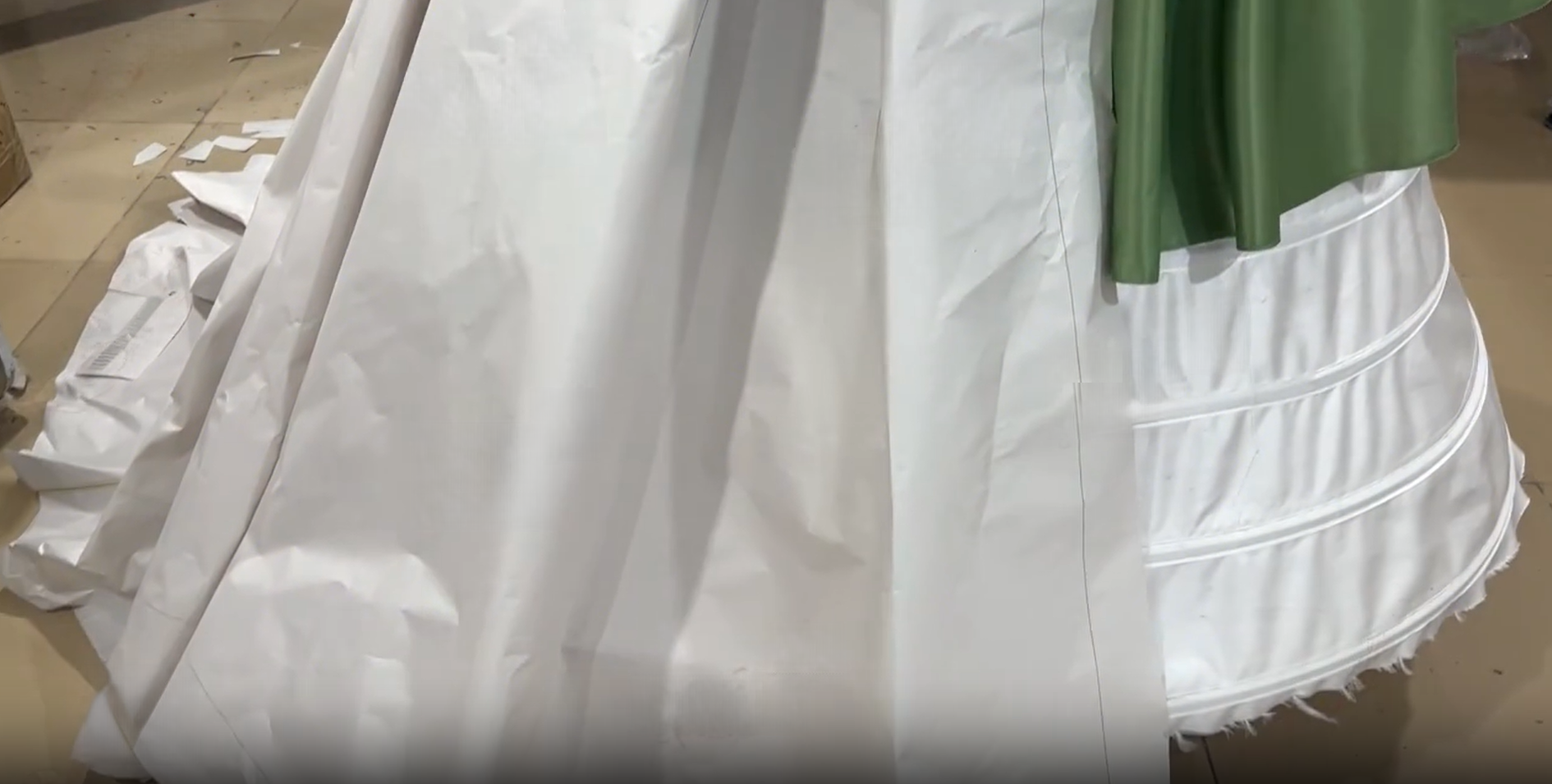
Every curve has a reason before the real fabric is touched.
That battered piece of white cotton, full of pinholes and erased chalk lines, would later be taken apart carefully. Every piece would be ironed flat, marked with grain lines, and filed away.
It became the master pattern. No one touched the green satin until Wang said that white muslin was right. And he didn't say it until the fourth day.
It is easy to look at a finished ball gown and see only volume and drama. The pattern is where that drama is quietly decided.
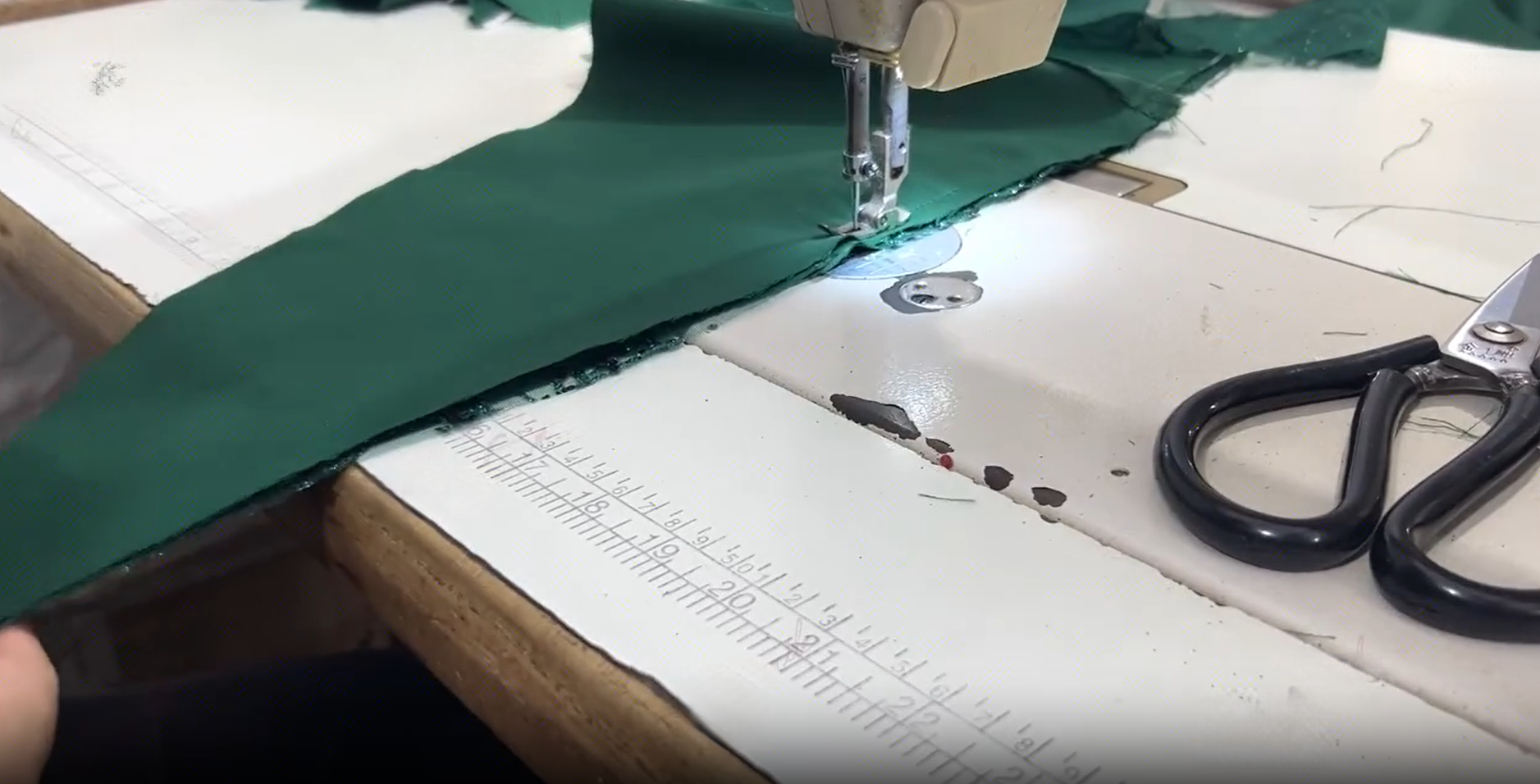
When the real fabric finally arrived, a deep boxwood green satin, the atmosphere in the cutting room changed.
The cutter, a woman named Liu who had been in the trade since the 1990s, treated it like a surgical procedure. She did not fold the satin to cut two layers at once. That would invite misalignment.
Instead, she laid it flat in a single layer, weighted down the pattern pieces with metal discs, and traced each piece with chalk.
For the underskirt alone, she cut twelve separate gores, each one a large curved panel. Every piece had to align with the fabric's grain. A single degree off, and the finished skirt would twist on the body.
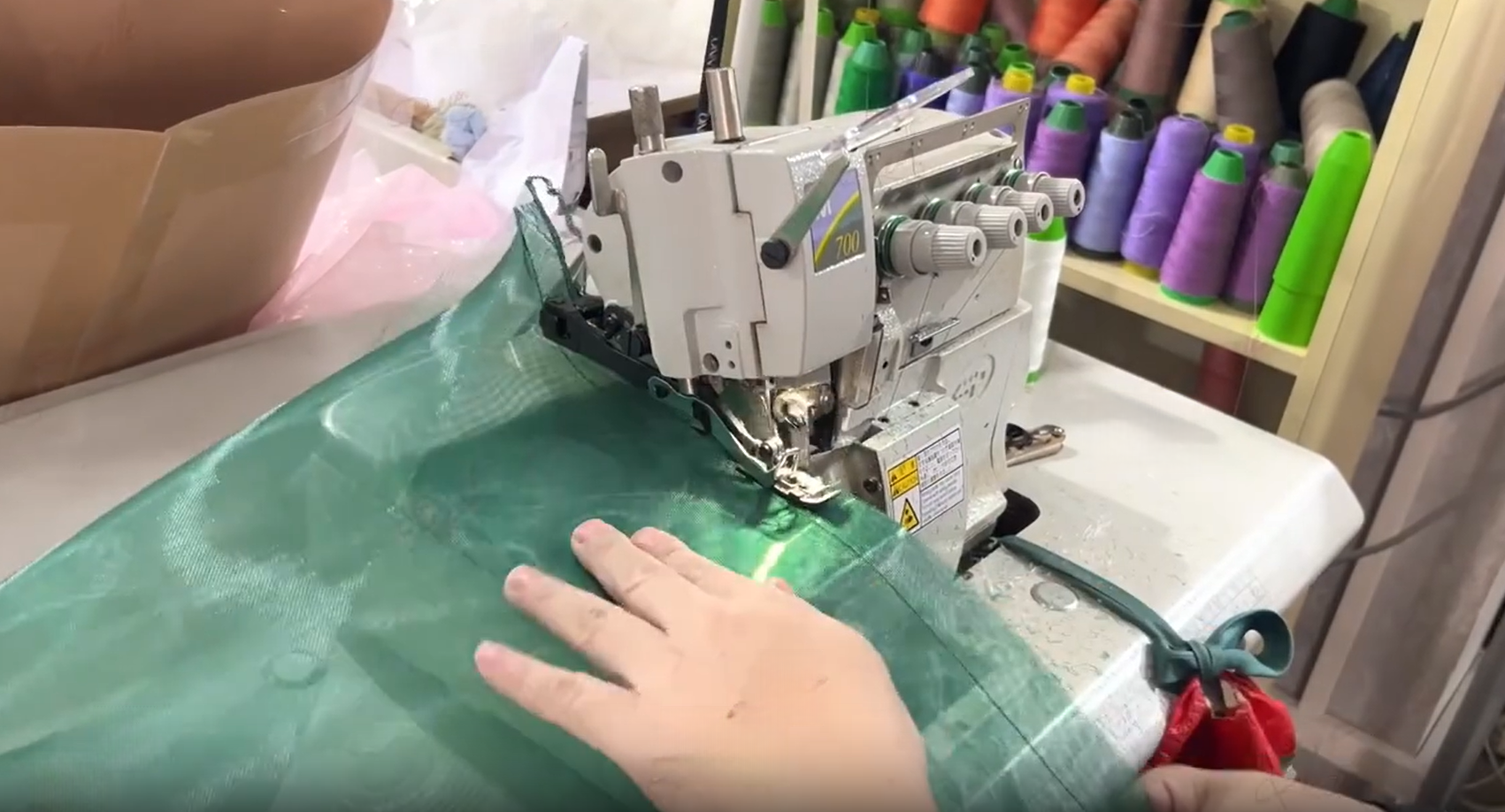
The overlocking also added a subtle stiffness to each panel, helping the gathered skirt hold its volume.
No one talked during this phase. Liu had a rule: if you talk, you lose concentration. She had ruined enough expensive fabric in her early years to know better.
That kind of patience is one reason long prom dresses with full skirts can look so polished when finished properly. The silhouette depends on dozens of small construction decisions that most people never see.
Nothing was printed onto the gown.
Every gold vine and red blossom had to become an individual piece before it could become part of the dress.
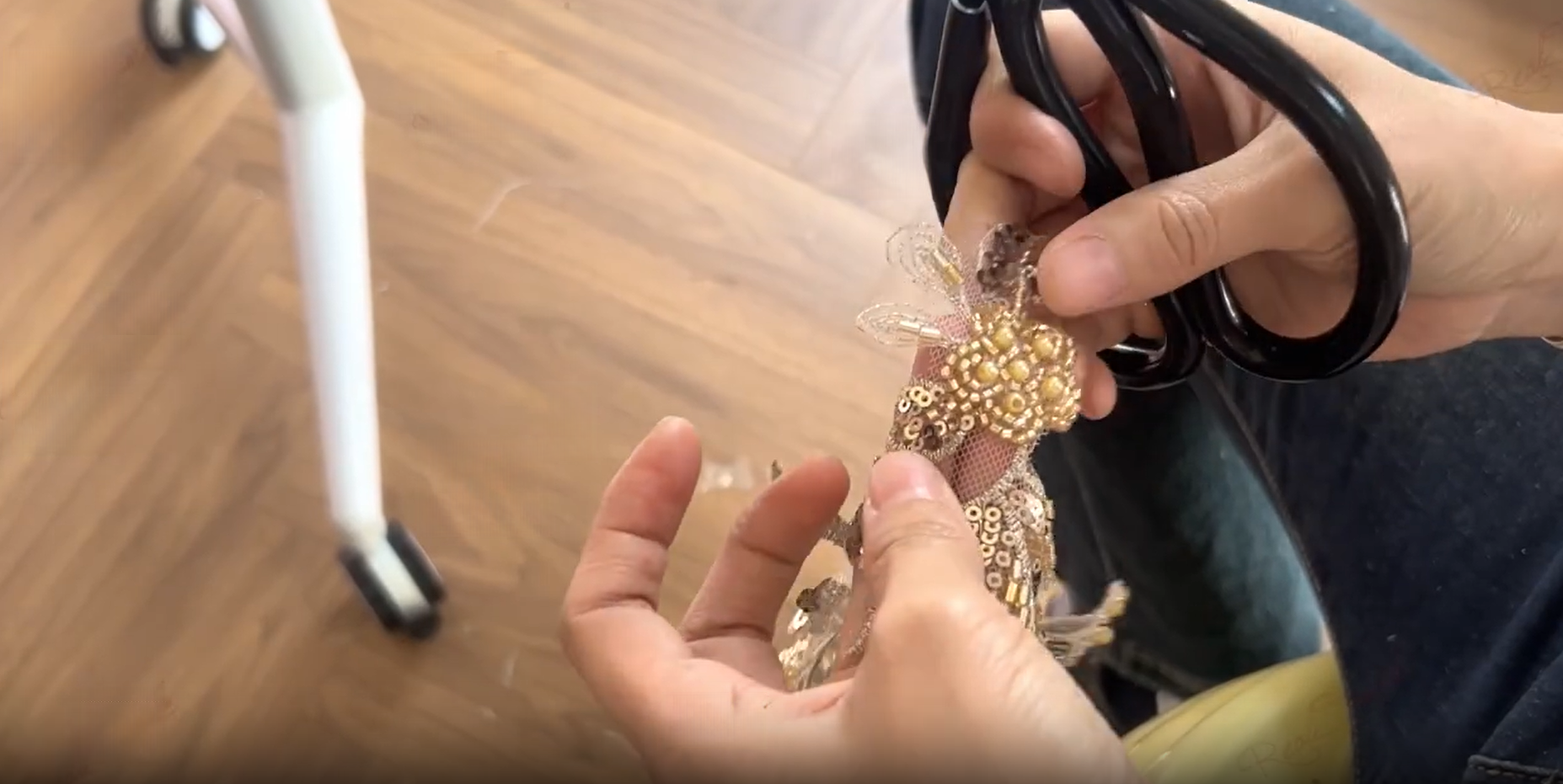
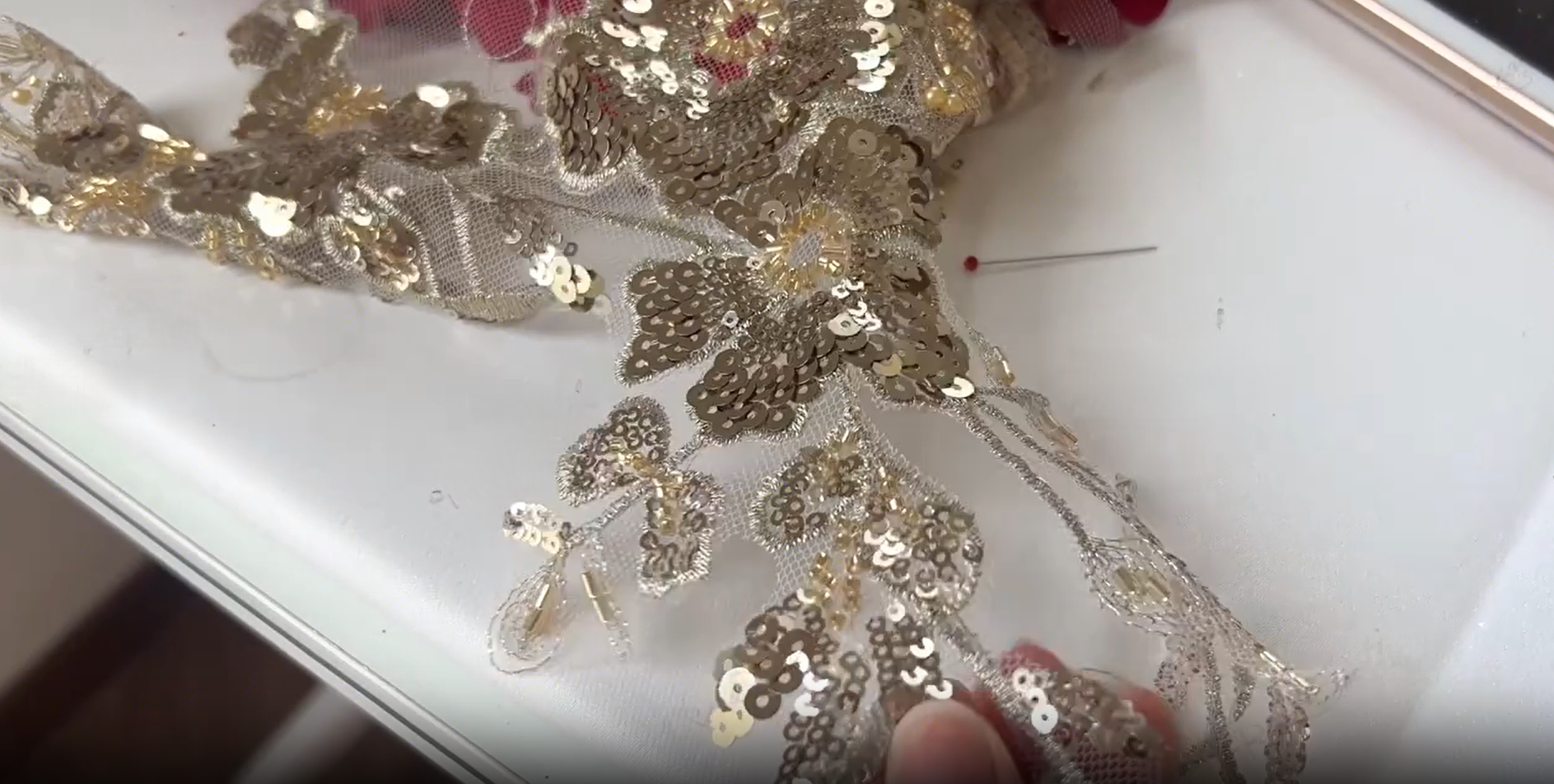
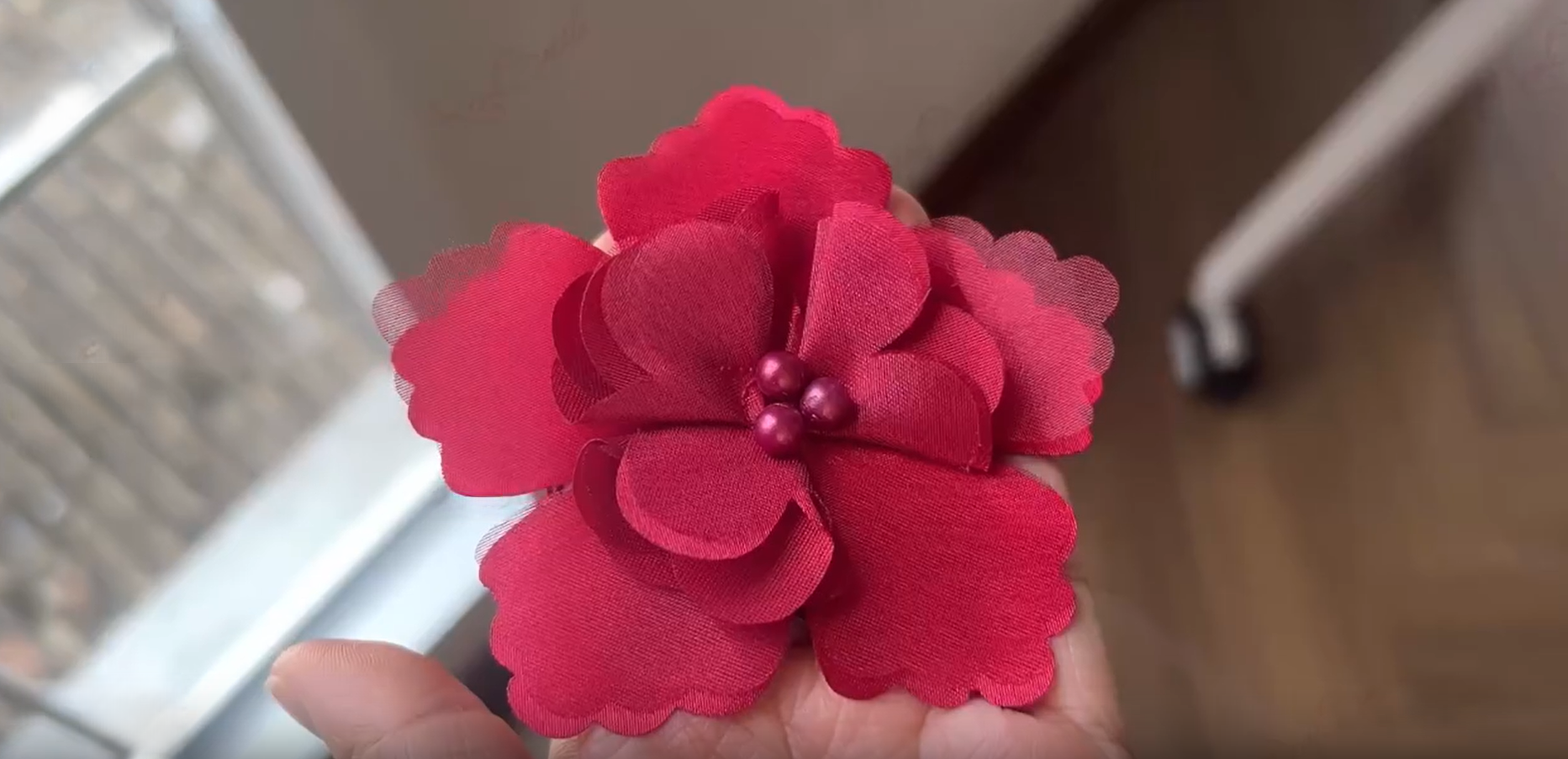
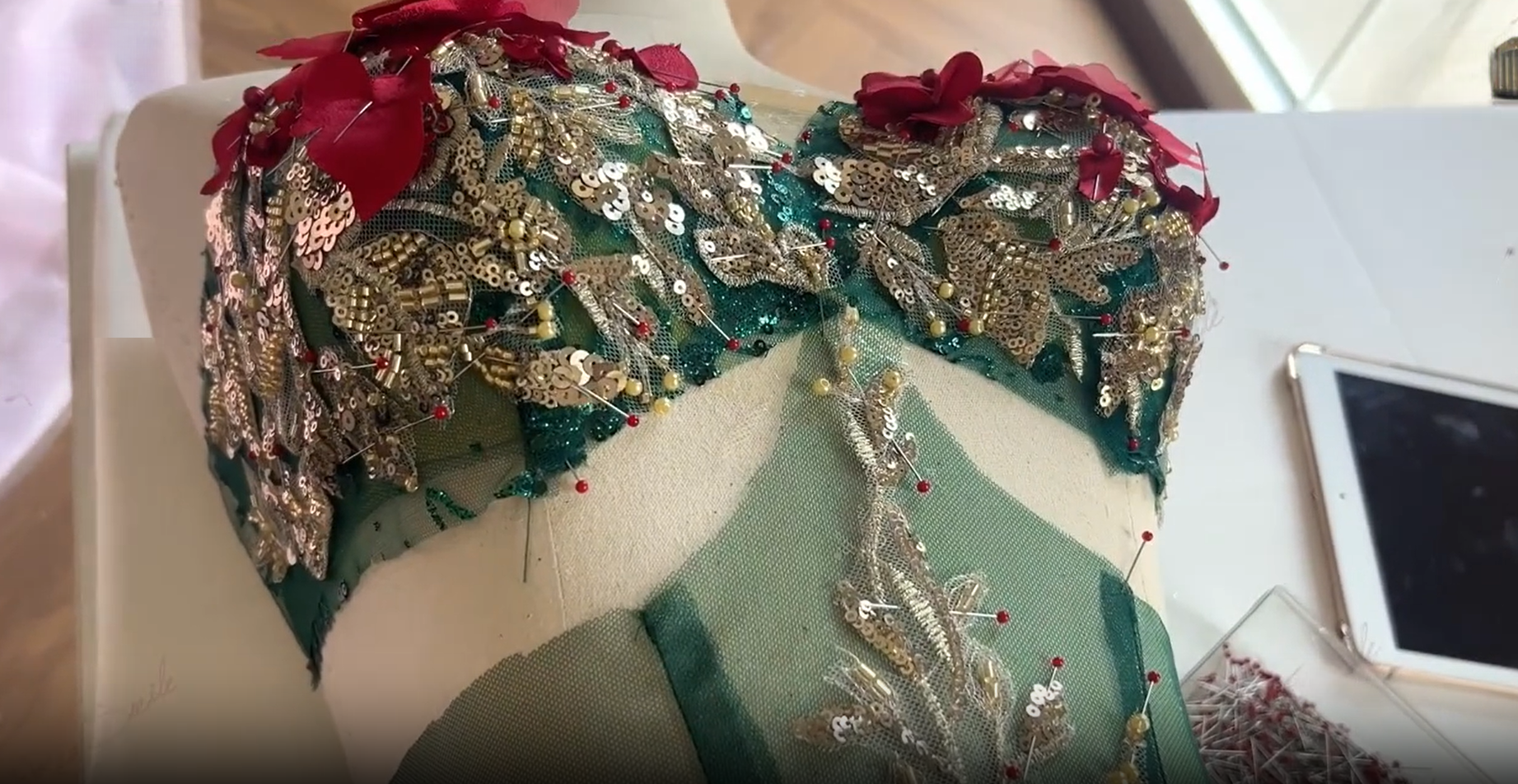
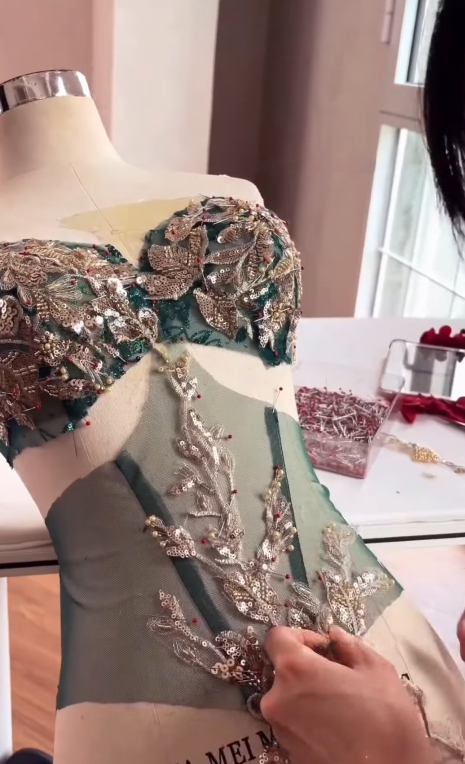
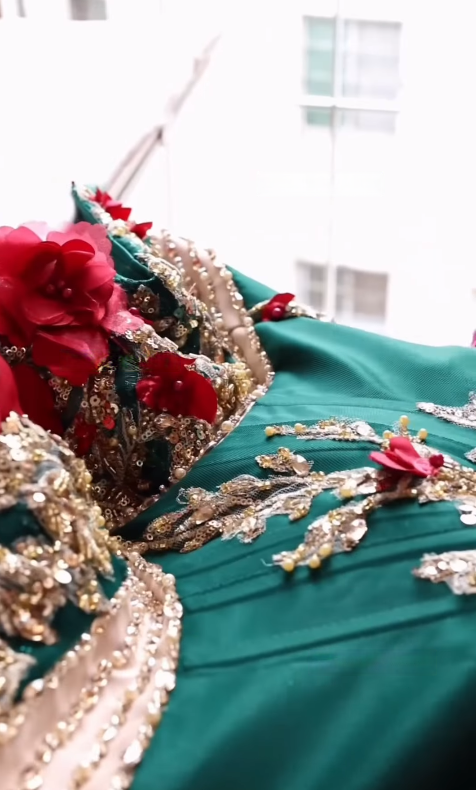
The decoration, all those gold vines and red blossoms climbing across the green, was not printed or stamped. Every single piece was cut, assembled, and stitched by hand.
The gold floral motifs came from a roll of beaded lace imported from Lyon. It was dense with sequins, metallic thread, and tiny glass beads. Beautiful, but unusable as a whole sheet.
Each individual flower and leaf had to be cut out of the surrounding netting with small curved scissors.
A young woman named Lin, who wore thick glasses and worked under a magnifying lamp, did most of this. One wrong angle, and she could snip through a thread holding a sequin.
A beautiful applique is not one piece. It is dozens of small decisions that have to survive being worn.
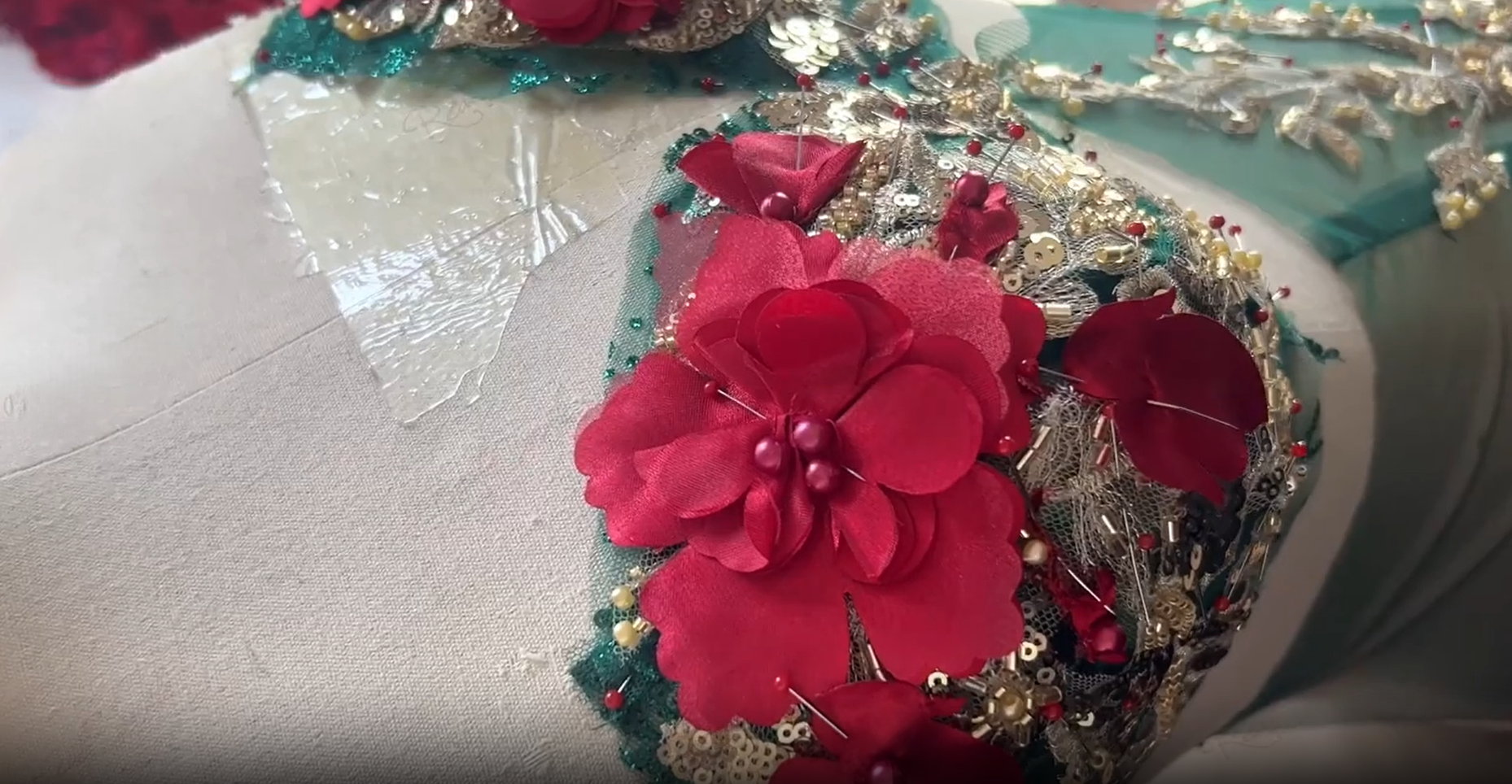
After a while, the women making them started giving names to the quirks. One particularly curled petal was called "the tight one." Another with a slightly scorched edge was "toast."
Once all the components were ready, the real puzzle began: arranging them on the dress.
The designer would place a large red flower on the right side of the bodice, step back, look, then move it three centimeters to the left. He would add a gold leaf next to it, then remove it.
At one point, he had pinned an entire vine arrangement along the side seam. He stood back, tilted his head, then unpinned the whole thing and reversed its direction.
"It was fighting the grain," he explained to no one in particular.
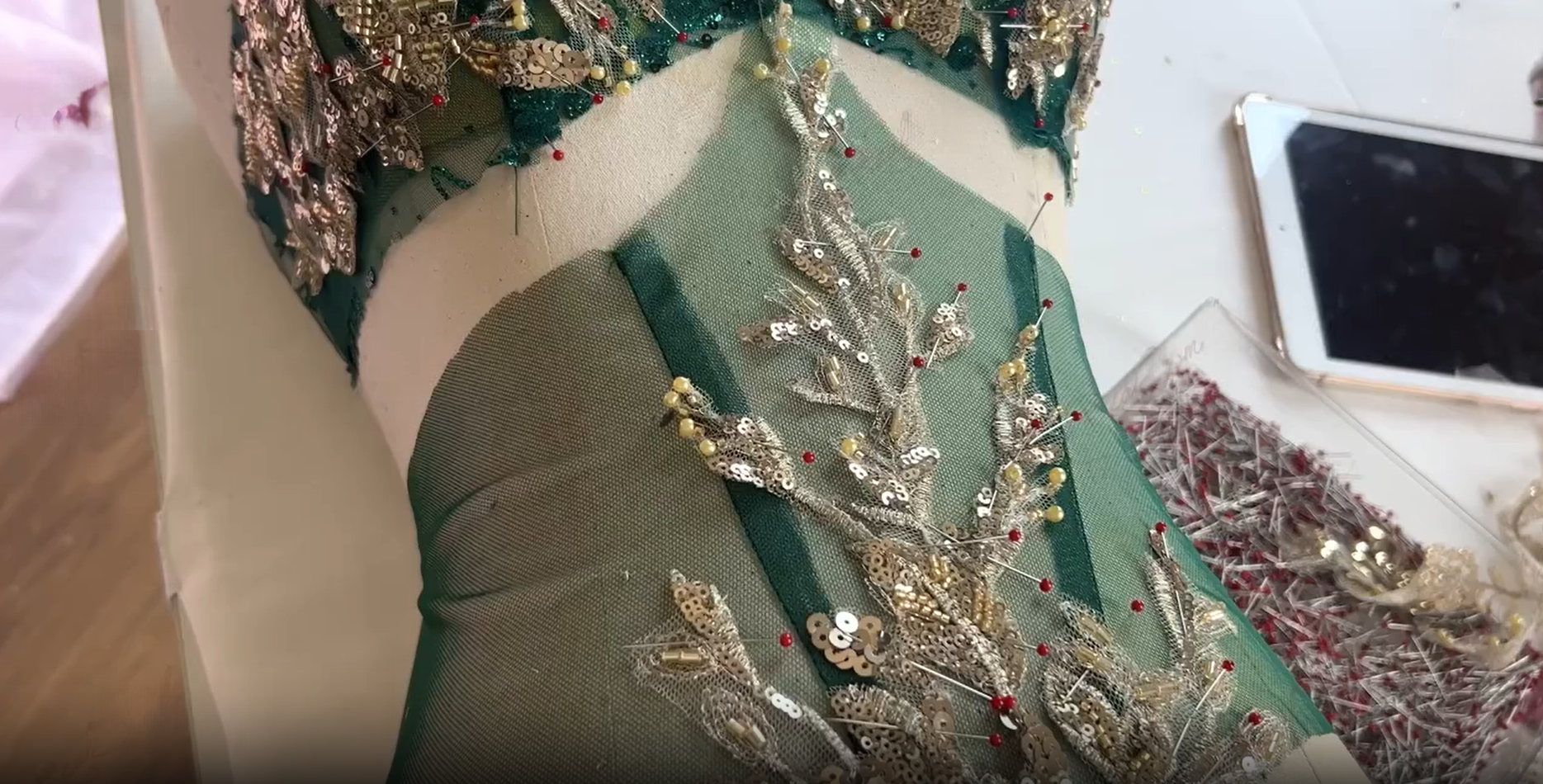
The hidden structure does most of the work.
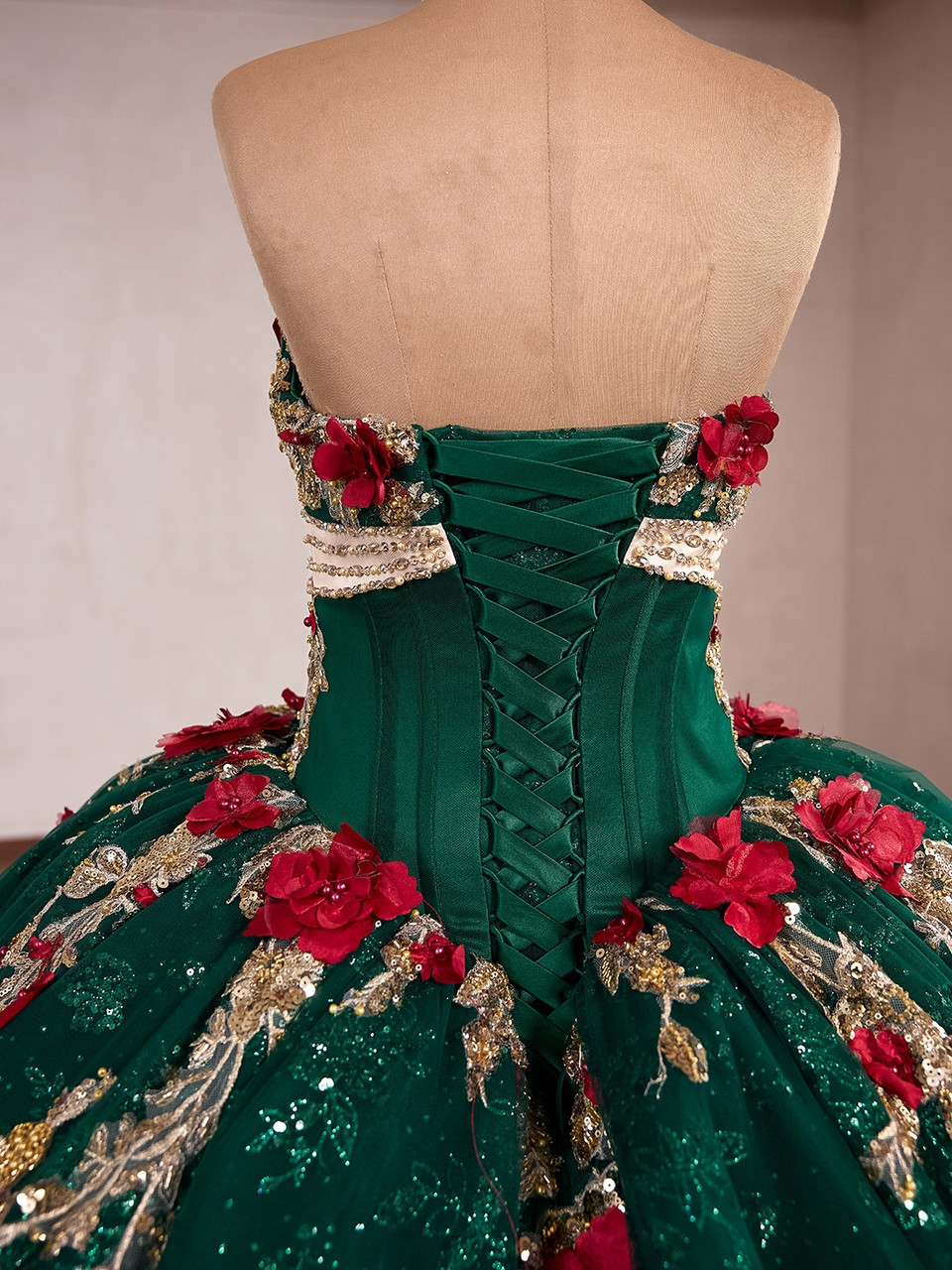
Beneath the green satin and tulle is a fully boned corset built from heavy coutil, giving the gown a structural foundation beneath the decorative surface.
Into this corset, we inserted vertical bones. Not plastic. Not the flexible spiral steel used in ready to wear. Solid, rigid steel stays, each one capped at both ends with a rounded metal tip to prevent it from piercing through the fabric over time.
The designer checked every bone channel before it was sealed. He ran his finger down each one, feeling the curve.
"Move it two millimeters inward. Otherwise it will press against the wearer's ribs when she sits."
The seamstress unpicked the channel and did it again.
The finished corset, before the outer layers were added, looked like a piece of armor. But it was the most important piece of engineering in the entire dress.
All the weight of the skirt, several meters of satin, layers of tulle, and all the hand sewn embellishment, would hang not from the shoulders, but from the wearer's waist and hips.
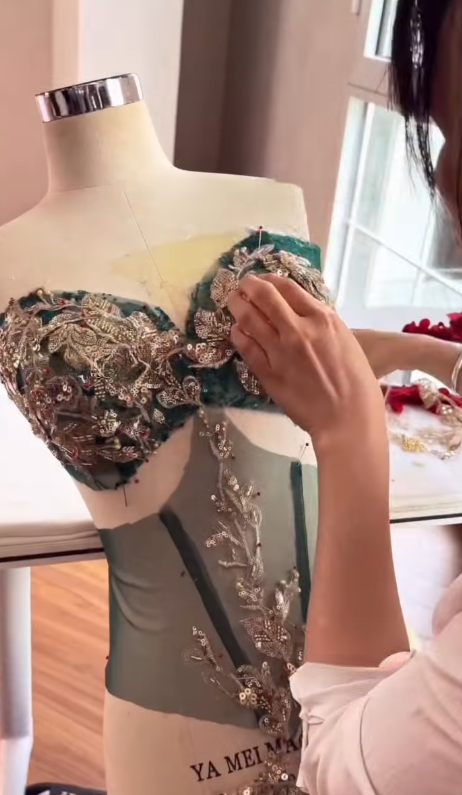
The silhouette was designed to change.
One of the more unusual requests was modularity. The designer wanted the gown to work in three configurations: strapless, with detachable long sleeves, and with a detachable waistcoat over the bodice.
The sleeves attached at the armscye with tiny hidden hooks, each one about the size of a grain of rice. The seamstress who made them used tweezers to sew them in place.
The waistcoat fastened with concealed snaps, arranged so that no closure was visible from the outside.

With detachable sleeves
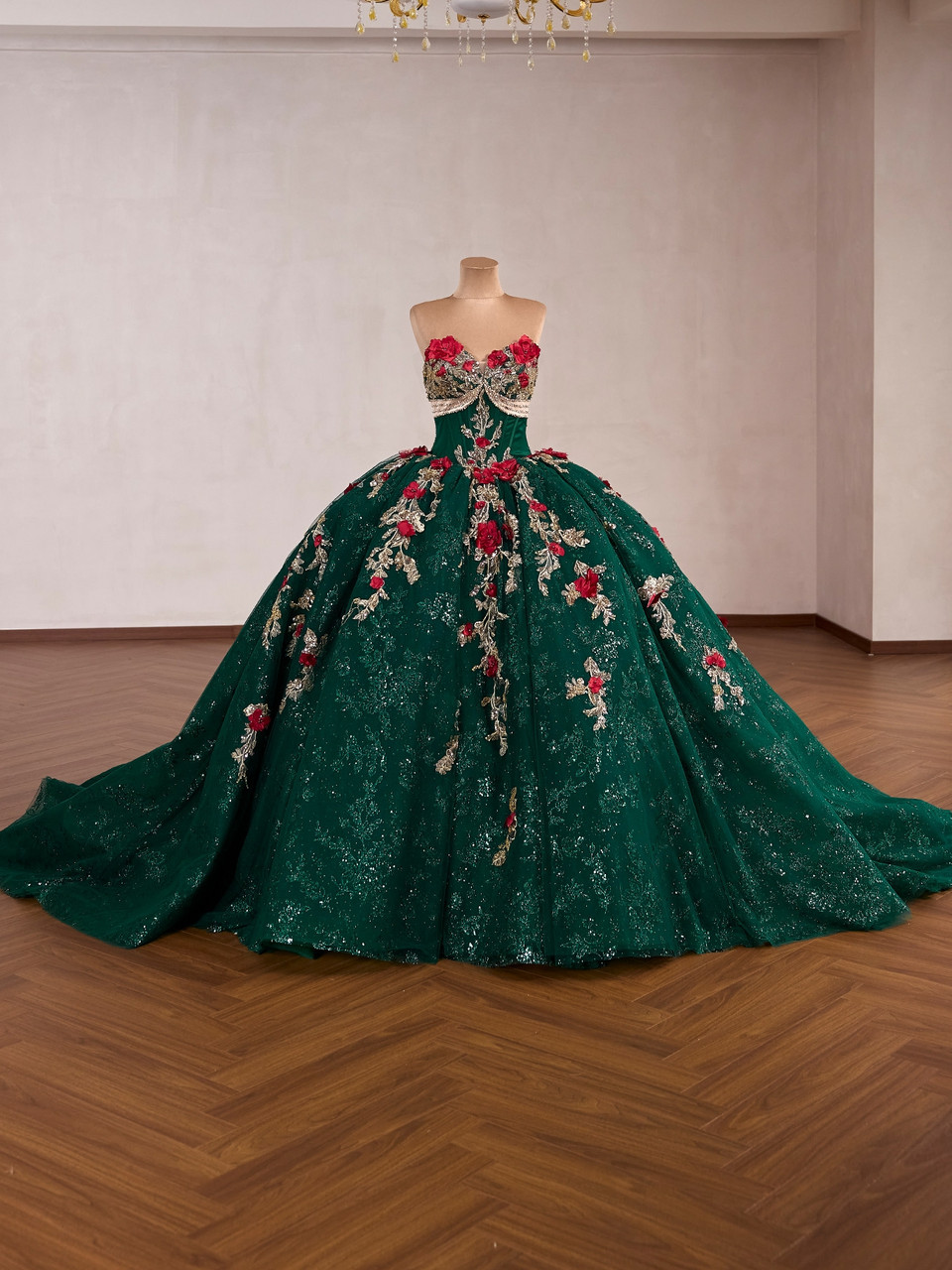
Strapless configuration
The first time a model tried all three configurations in one session, we timed it.
Removing the sleeves took about thirty seconds, mostly because the hidden hooks were hard to find by feel. Adding the waistcoat took ten seconds.
But when the model came out wearing it, the designer immediately frowned. The hem of the waistcoat and the waistline of the skirt had a visible gap, about a finger's width.
The intended effect of a clean, layered silhouette collapsed.
He pulled the waistcoat off right there, laid it flat on the table, and drew a new seam line in chalk.
"Take this in by one and a half centimeters. This afternoon."
The waistcoat went back to the sewing machine before it had even been worn for a full minute.
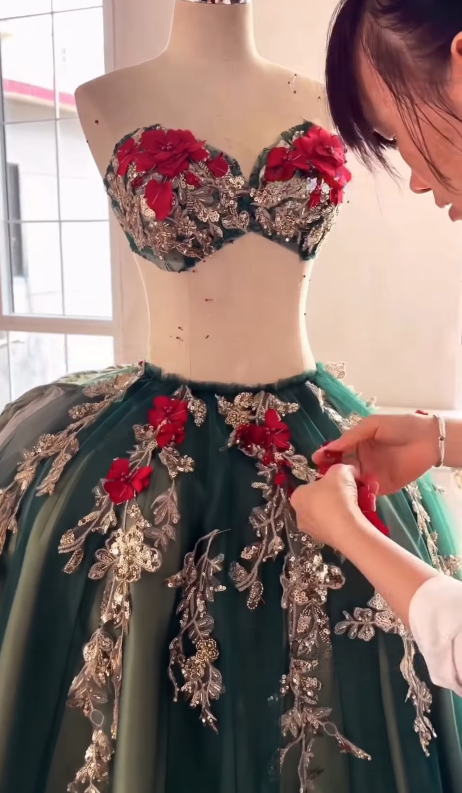
The woman who did most of this work was a senior seamstress named He. She was the quietest person in the workshop.
She used an invisible monofilament thread, thinner than a human hair, and worked from the back of the fabric, bringing the needle up through the base of each flower, then back down through the same hole, over and over.
Each flower was stitched down at twelve to fourteen points, ensuring it would not shift or lift when the dress moved.
For the gold beaded lace, He had a strict rule: never pass the needle through a sequin. The thread had to go through the netting around it.
If the sequin's own thread was accidentally cut, the sequin would loosen and stand up at an angle, a small, glittering mistake that would catch the light and give itself away.

Watching her work was almost hypnotic. She barely blinked. She did not listen to music or talk to anyone. She simply sewed, one stitch at a time, for hours.
When she finished a section, she would run her fingertips over it, feeling for any loose end, any bead that was not lying flat.
If she found one, she would cut the thread and redo it.
That is the difference between something that simply photographs well and something that is constructed to move with a wearer.
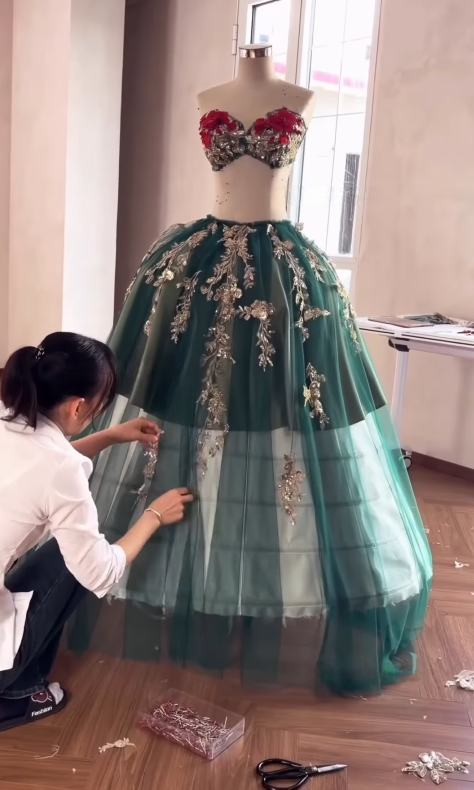
A dress form is a lie.
It does not breathe. It does not shift weight. It has no asymmetry. The first real fitting is where the dress either passes or fails.
The model stepped into the gown, and the atelier gathered around. The zipper went up. The skirt settled. For a moment, everyone just looked.
Then the designer knelt down. He checked the hem. Was it level? Did it clear the floor by the right amount?
He had the model walk three steps. The hem caught the front of her shoe.
"Let it out half a centimeter."
An assistant marked the spot with a pin.
He stood up and circled the model slowly. He checked the side seams for any strain. He checked the back, near the underarm, where the top of a steel bone was pressing just slightly against the satin.
"Wrap the cap three millimeters deeper," he told He. "It will show otherwise."
The detachable sleeves went on. The waistcoat followed.
The model turned, walked, sat down, stood up. The designer watched every transition. He asked her to raise her arms. He asked her to spin.
The skirt flared and settled.
This was not a formality. It was the dress's first conversation with a real body, and that conversation demanded revisions.
None of this was treated as failure. It was the reason the fitting existed.
The atelier was not finished with it when the sewing stopped.
The dress left the atelier on a Friday afternoon, packed into a large white cotton cover, the kind that looks like a cocoon.
Two movers carried it carefully down the narrow stairs.
Someone asked the designer:
"Are you happy with it?"
He watched the white bundle disappear into the van, then shrugged.
"I won't know until she wears it to the party."
If someone steps on her hem while dancing, he explained, they were two millimeters off somewhere. They would find out.
Then he turned and walked back to the empty dress form.
There was already a new roll of muslin leaning against it, and a new job number written on a piece of tape.
"Next one starts Monday."
A Garden Gown Built One Decision at a Time
From the first muslin toile to the final fitting, every part of this gown was adjusted for proportion, movement, structure, and detail.
Explore This Green Prom DressA finished dress makes the process look effortless.
But behind the effortless part are hundreds of small decisions: one centimeter at the waist, three millimeters at the underarm, one flower moved to the left, one seam opened and sewn again.
The dress is finished. The decisions remain in it.
Explore More Ball Gown Making Stories
From floral beadwork to layered skirts, discover the construction details behind custom statement gowns.
See how an ocean inspired concept becomes a layered couture gown.
Take a closer look at the making of another structured green ball gown.
Follow the construction process through a detailed photo gallery.
Understand the complete path from raw fabric to finished dress.