
The Crystal Work Behind a Mint Green Ball Gown
9th Sep 2026
The Making of a
Mint Green
Crystal Ball Gown
From custom sequined tulle and corset boning to hand sewn crystal chains, every visible detail began with a construction decision.
follows structure.
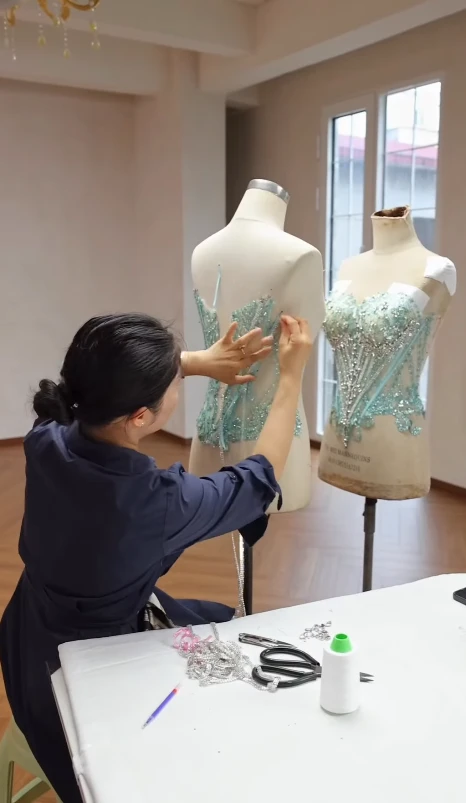
Every gown that leaves our atelier begins with a conversation, a fabric direction and several samples that do not make the final cut. For this design, we developed a custom sequined tulle in two colorways, soft blush pink and mint green. The gown documented here became the mint green version.
The surface was designed before the sparkle was added.
The fabric had to do some of the visual work before a single crystal was sewn.
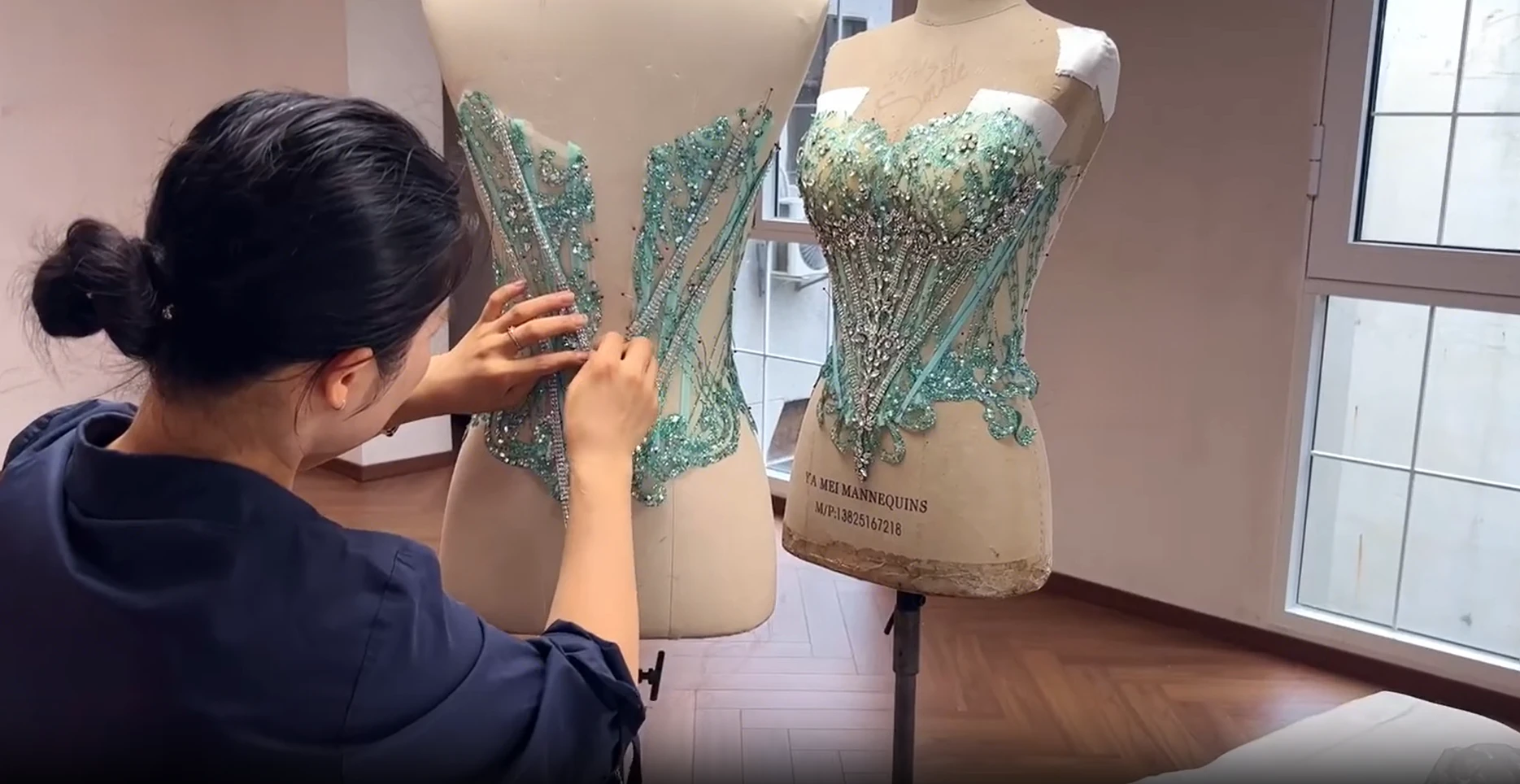
Silver and mint green sequins are embroidered into a vine pattern across the custom tulle. Light moves across the surface as the wearer moves, allowing the gown to appear dimensional even when the body is still.
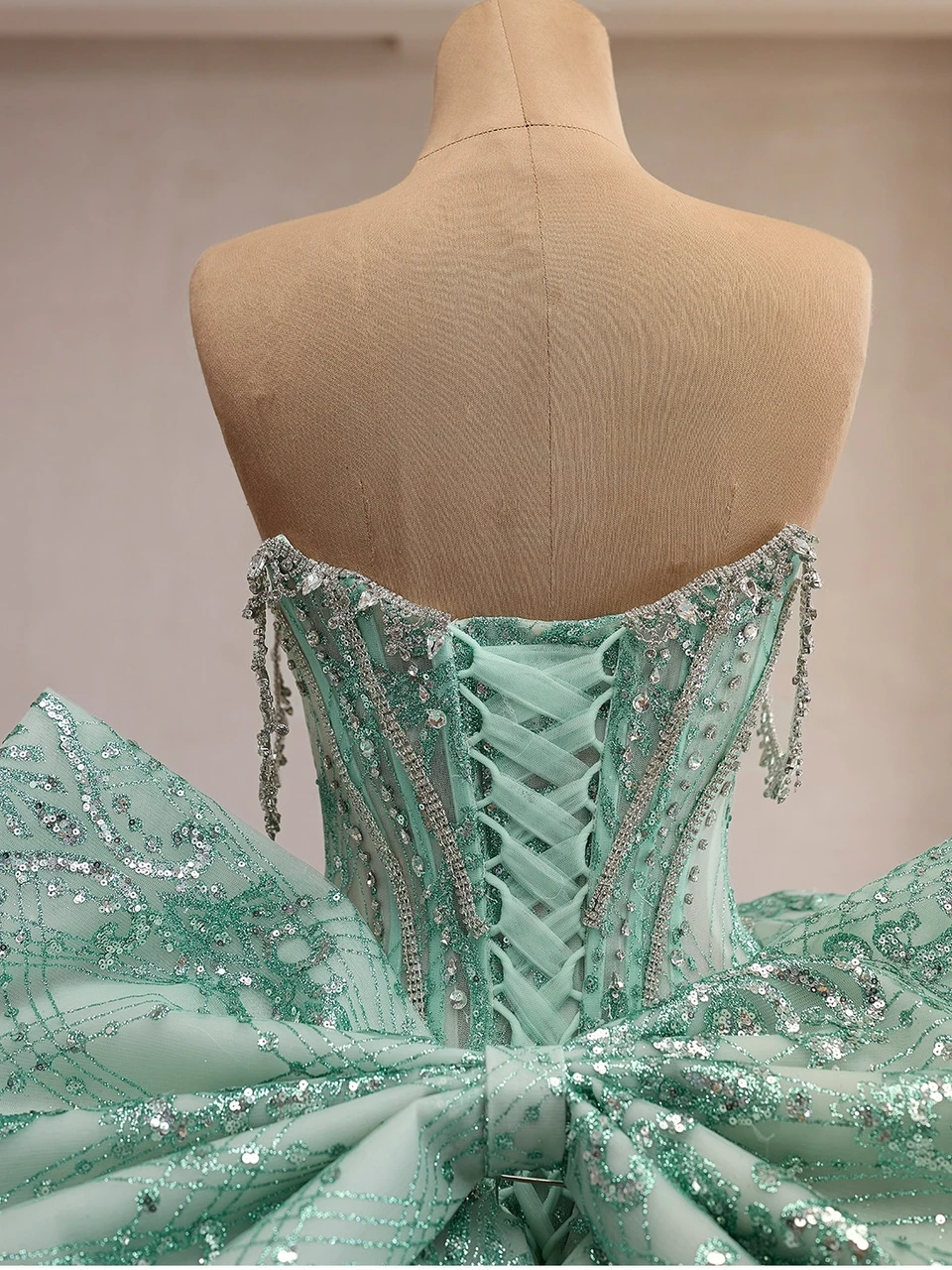
The bodice required another layer of visual control. Rather than simply adding more sparkle, we introduced crystal lines and teardrop rhinestones where they could redirect light and reinforce the shape of the corset.
The finished design belongs to the same family as our green sequins strapless beading prom dress , but the construction documented here goes deeper into the pattern, crystal placement, corset structure and hand embellishment behind the finished gown.
The crystal line had to be designed independently from the support underneath.
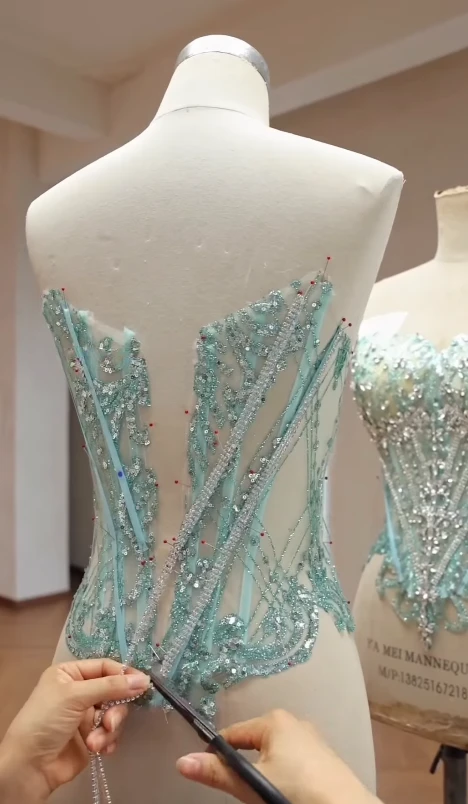
The original plan was simple: place the silver crystal chains directly over the boning channels. Once the sample was tested, that approach created two problems, one against the body and one across the visual line of the bodice.
A rigid crystal chain should not become a hard ridge.
Cup-chain has natural rigidity. Placing it directly over plastic or steel boning can make the line noticeable against the body, particularly during a long prom, gala or wedding event.
The body does not create perfectly straight structural lines.
The bust narrows toward the underbust, the ribcage changes proportion and the waist pulls inward. Boning follows those contours, while a rigid crystal chain naturally wants to straighten.
Visual line outside.
Boning provides support from inside the bodice. Crystal chains create their own controlled paths across the surface.
The chain had to survive the curve.
Several suppliers were tested before the final crystal chain was selected. The material needed to remain visually clean while allowing enough flexibility for a fitted corset bodice.
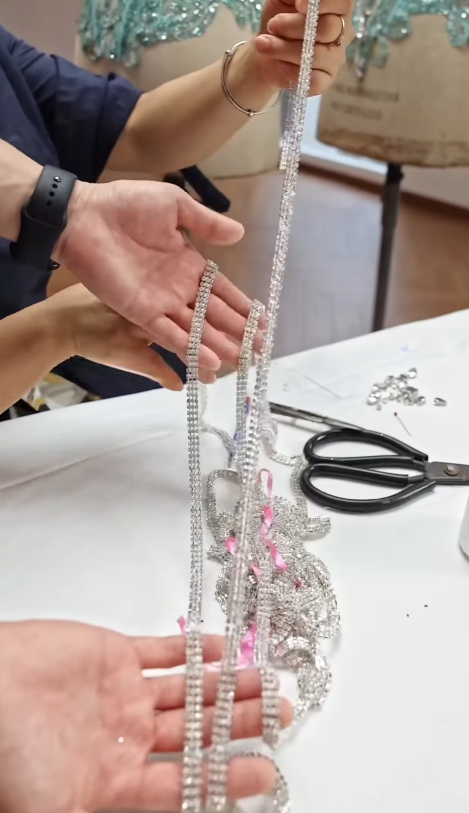
Four prongs per crystal
Each stone is held in a silver toned metal setting rather than relying on a simple glued attachment.
Continuous cup-chain
Individual crystal cups are linked side by side, creating a clean visual line with controlled flexibility.
Cut by measurement
Bulk rolls are divided into individual segments according to the measurements required for each size.
Nothing is sewn until the composition works on the body.
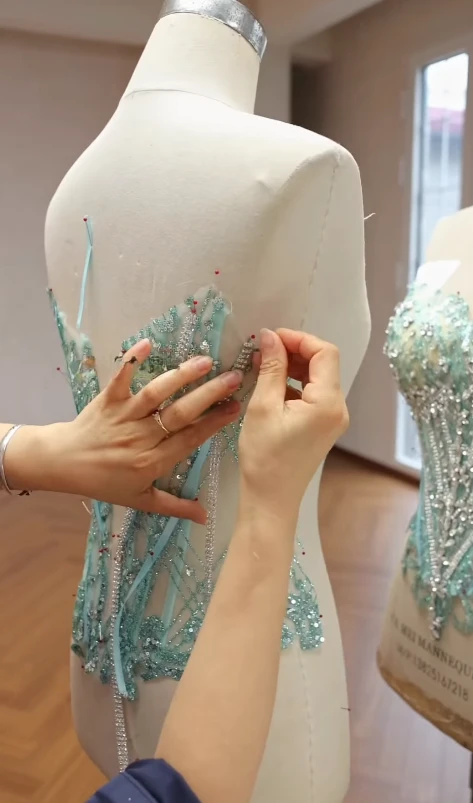
The dress form becomes part of the design process here. Sequined tulle is positioned first, followed by the crystal chain, one section at a time.
Measurements are repeatedly taken from center front to each chain placement because even a small difference becomes visible across a fitted bodice.
The crystal lines taper visually from bust toward waist. Their angle is controlled so the torso does not appear visually shortened.
The chain is not pulled completely tight. Controlled ease allows it to respond when the wearer sits, moves or raises an arm.
The back is not an afterthought.
Crystal chains converge slightly toward the center back while stopping short of the closure area, keeping the zipper and seam allowance clean.
One crystal map cannot simply be enlarged from size 2 to size 16.
Bust to waist proportions change as sizes change. Crystal lengths and placement points therefore have to be recalculated rather than treated as a uniformly scaled graphic.
The slow part is where the surface becomes secure.
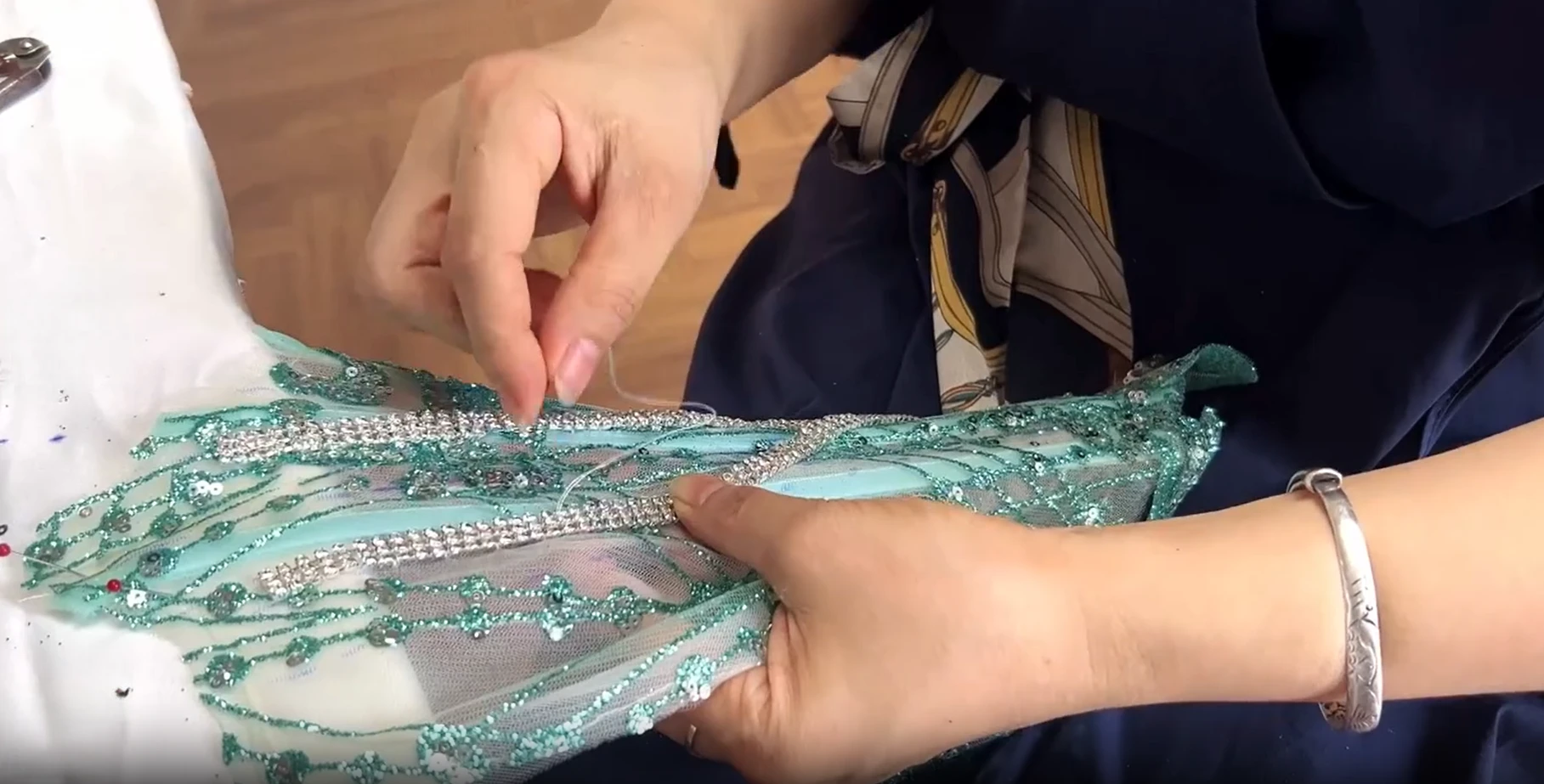
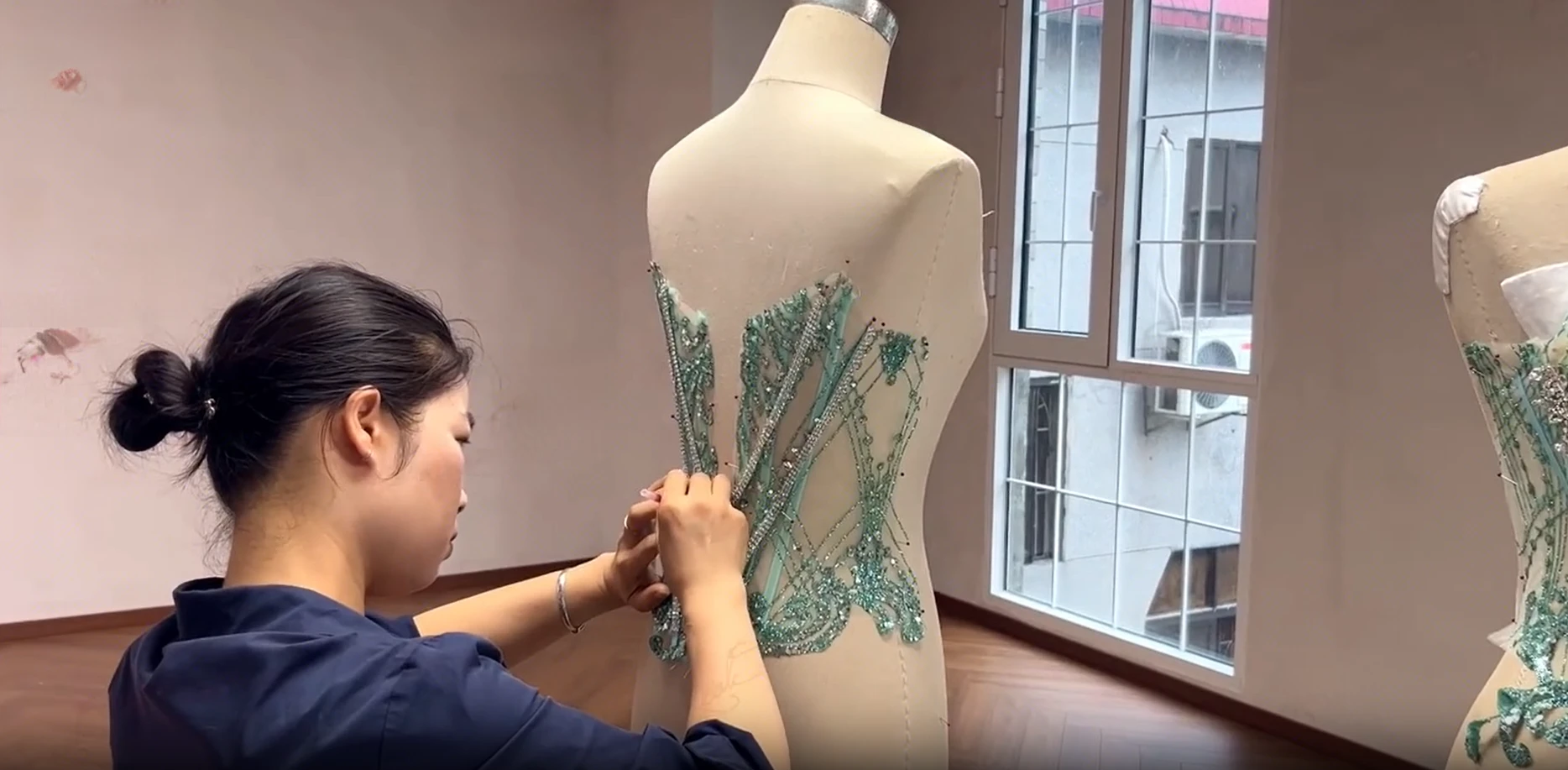
Machine sewing is not appropriate for attaching a metal crystal cup-chain directly to the embellished tulle. The final attachment is done by hand.
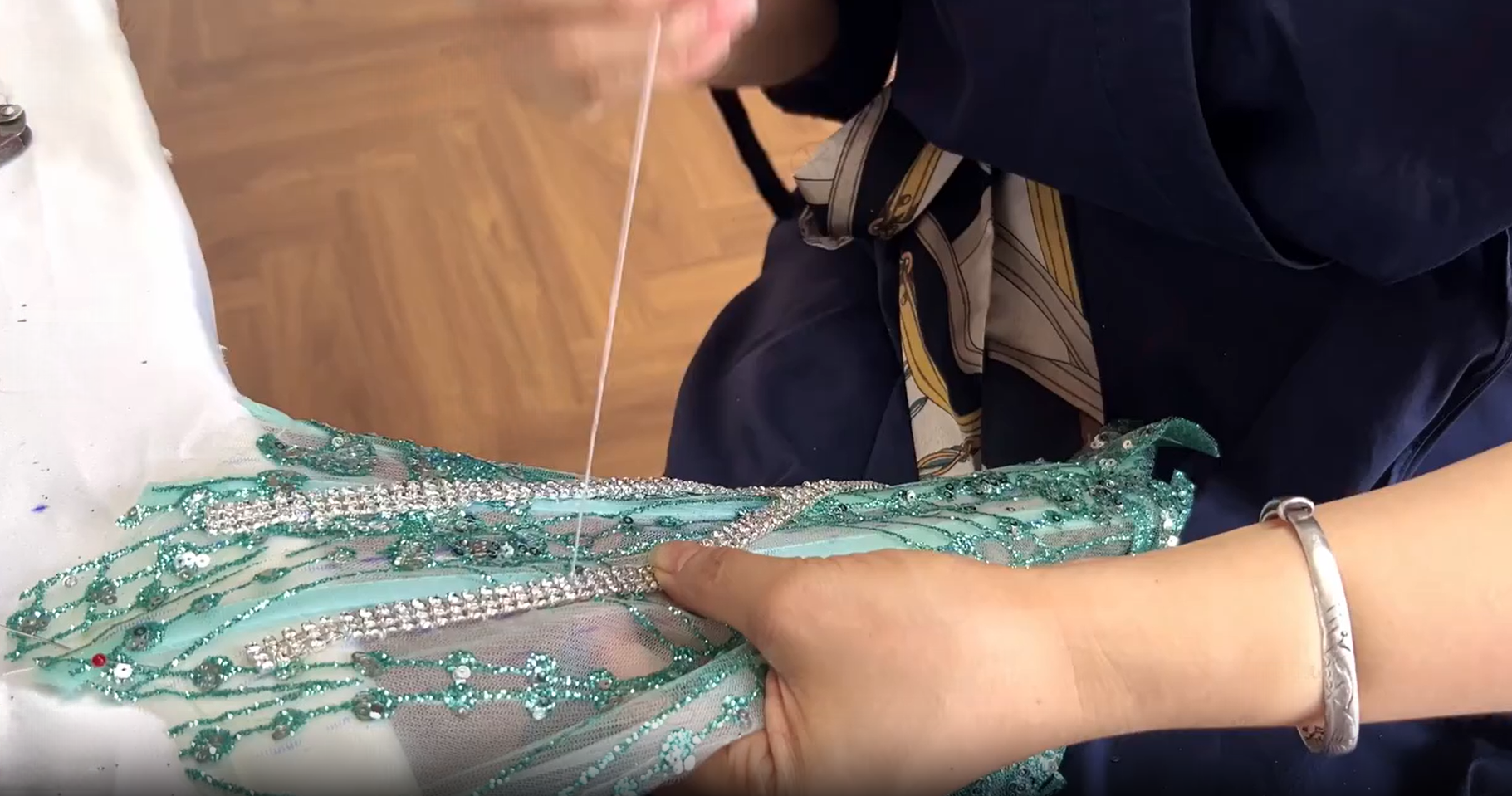
A fine beading needle passes through the crystal cup, the tulle and back again.
Nylon thread is used because it resists fraying against the metal settings.
Individual attachment means one snag does not automatically release an entire crystal line.
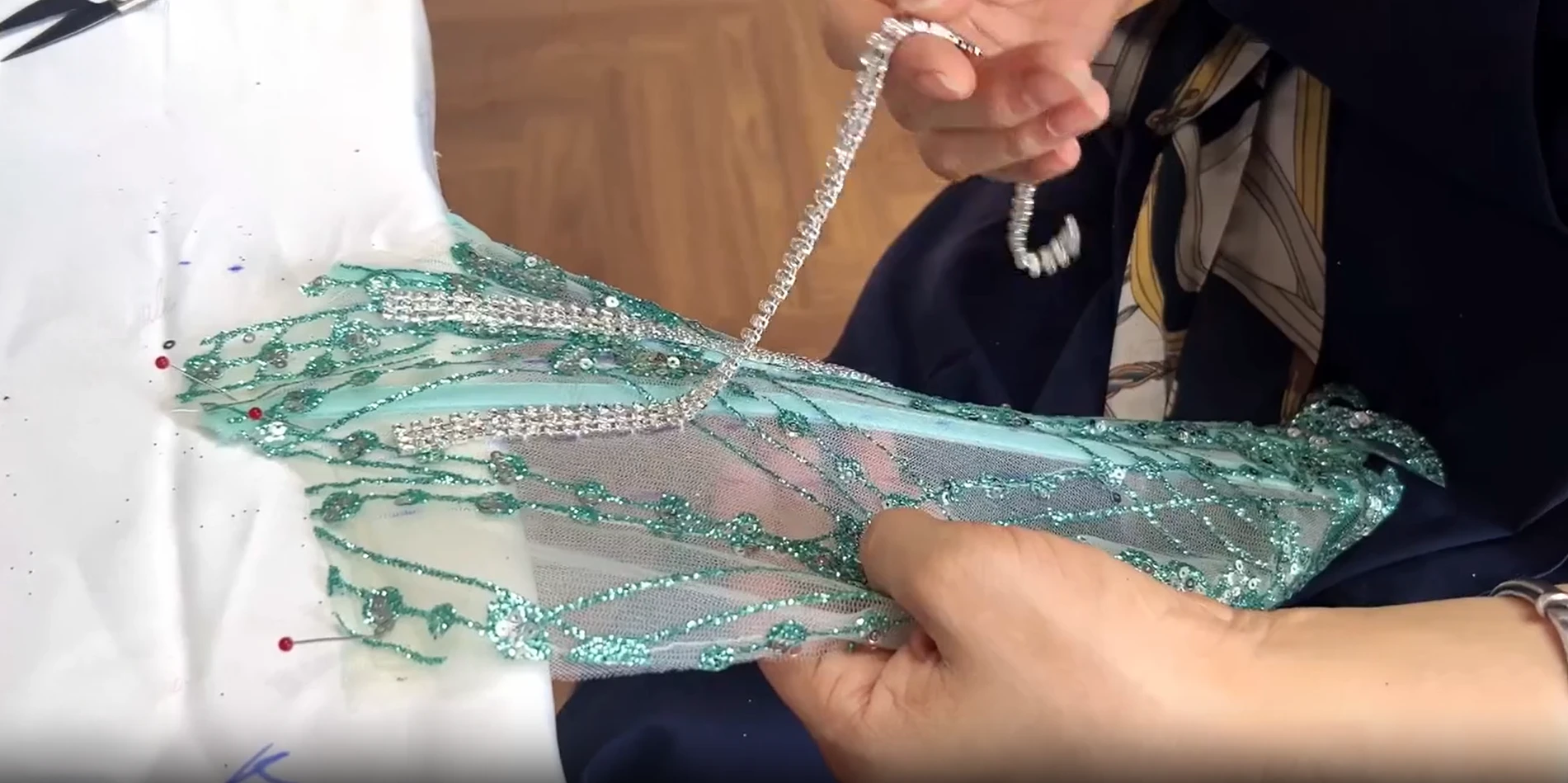
Larger teardrop rhinestones are attached separately through their drill holes. Their placement is concentrated around the center bust, natural waist and selected points along the sweetheart neckline, where visual weight helps reinforce the bodice.
Once the handwork is secure, the gown returns to the machine.
The next stage joins the embellished panels into a functioning garment while protecting the sequined surface.
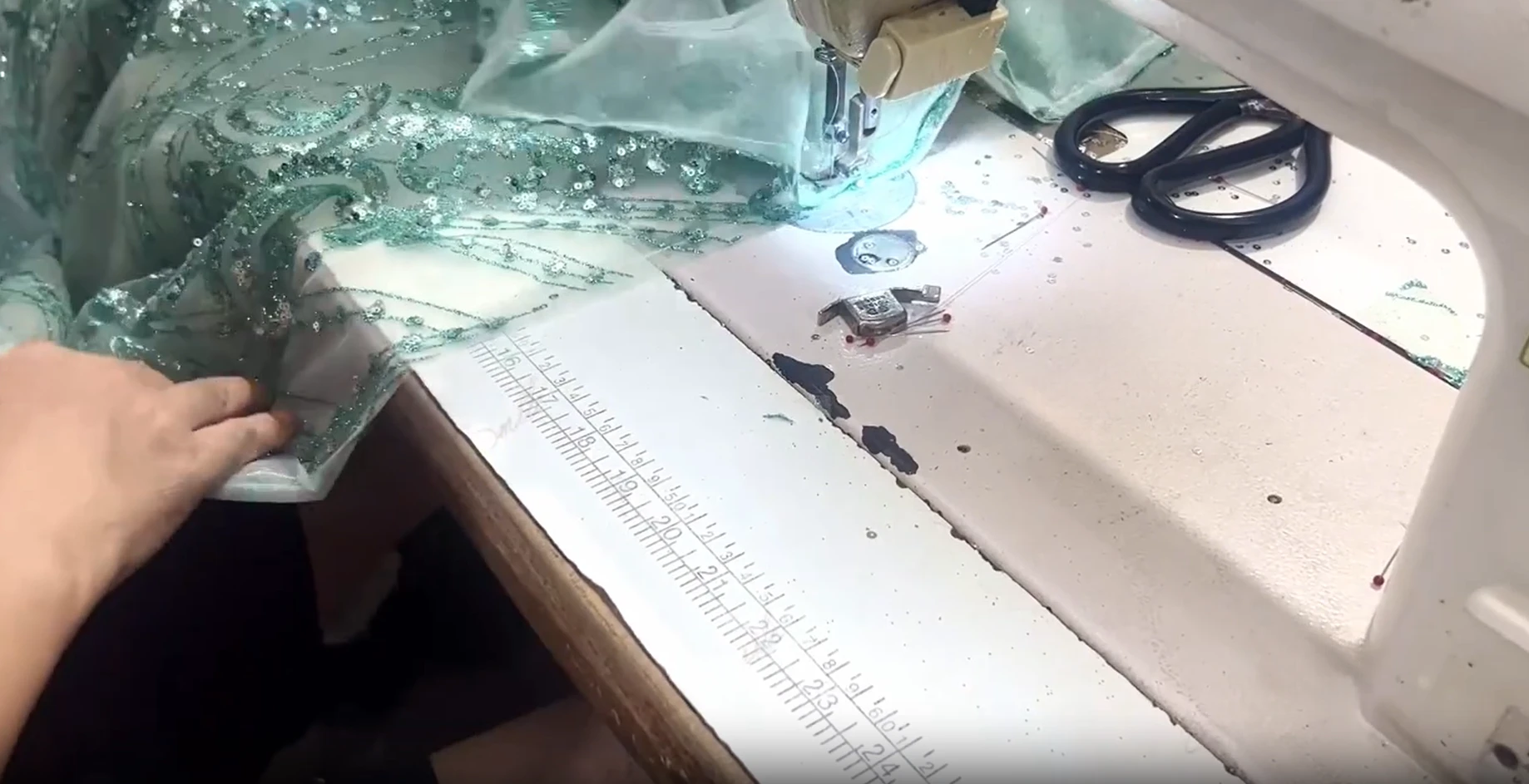
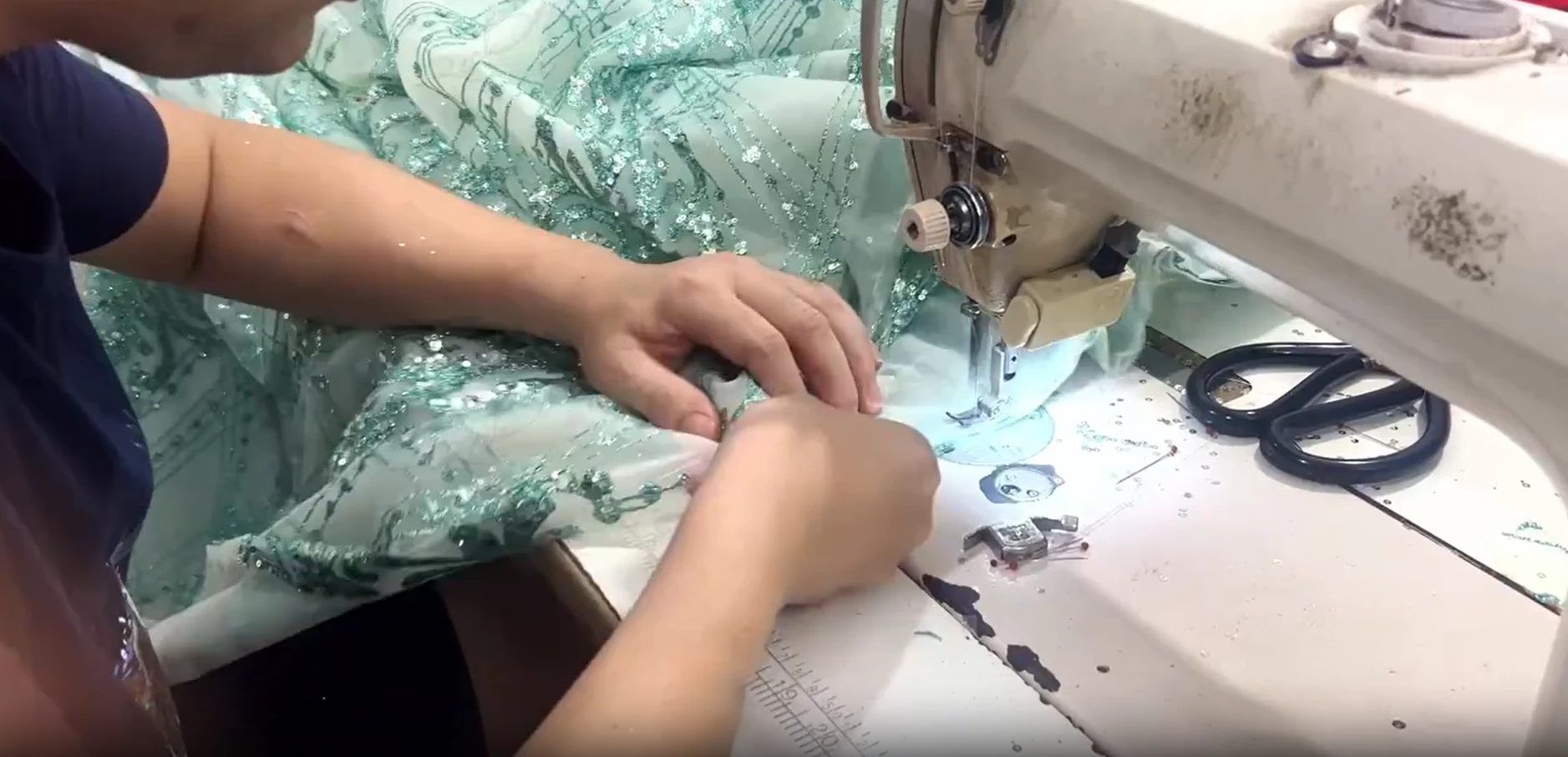
An industrial straight stitch machine handles the layered tulle, lining and boning casings. A walking foot helps prevent slippery tulle from shifting beneath the needle.
Side seams and center back are joined, boning is inserted into its channels and the lining is attached. The neckline and armholes receive a narrow facing.
Pressing is handled carefully. Sequins do not respond well to direct high heat, so a press cloth is used to protect the embellished surface.
For gowns where embellishment becomes part of the construction language, explore our heavy beading wedding dresses for formal events . The same principle applies: decoration works best when it supports the garment rather than simply sitting on top of it.
Before the mint green fabric, there was muslin.
The toile is where volume, waist placement and silhouette are solved before the expensive fashion fabric is cut.
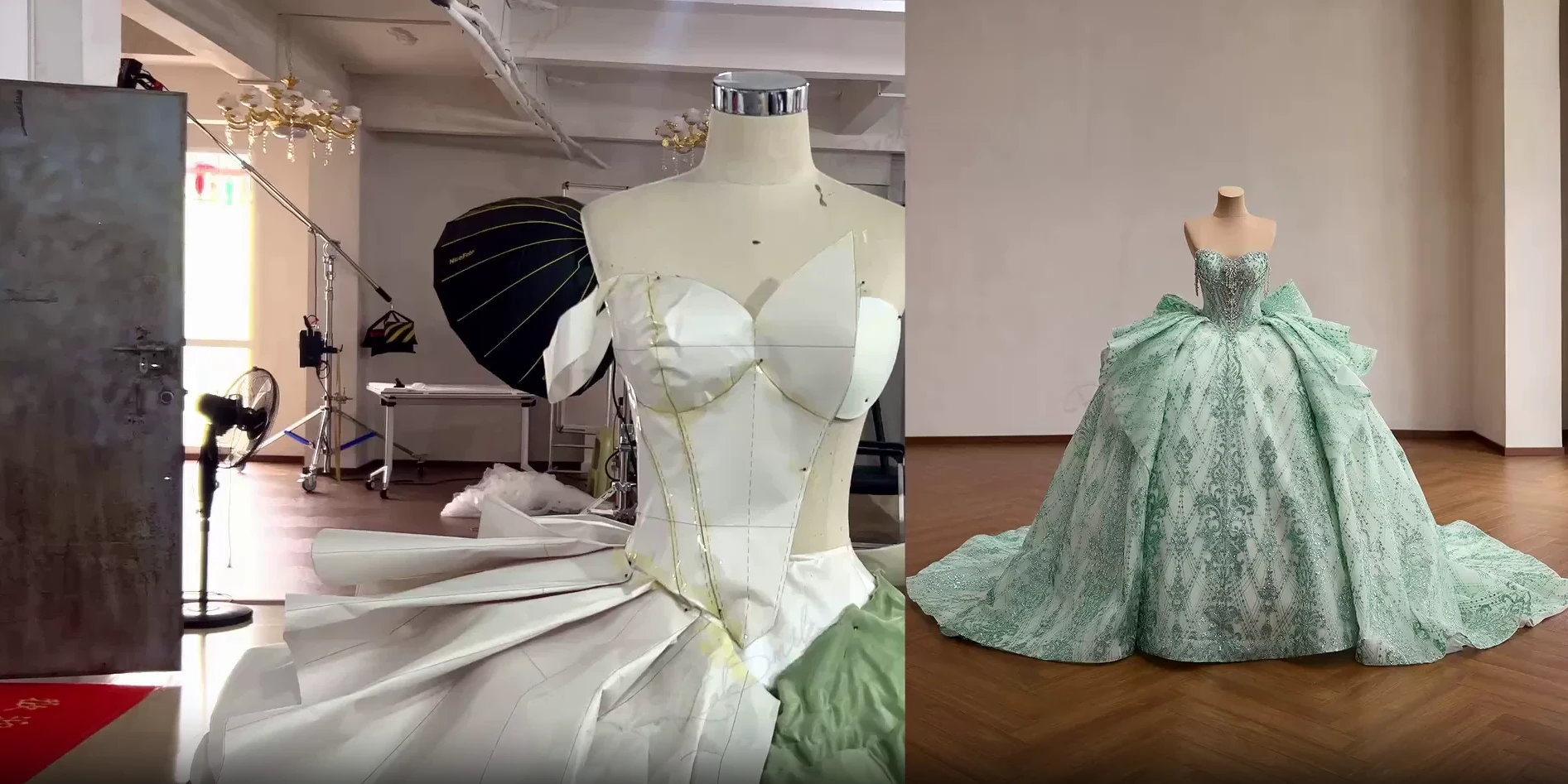
Fitted bodice / natural waist / full skirt
Layered tulle over a satin underlayer
Structured hip detail with moderate train
The structured hip detail is introduced after the skirt is assembled, allowing it to balance the fullness rather than compete with it.
The details finally become part of the silhouette.
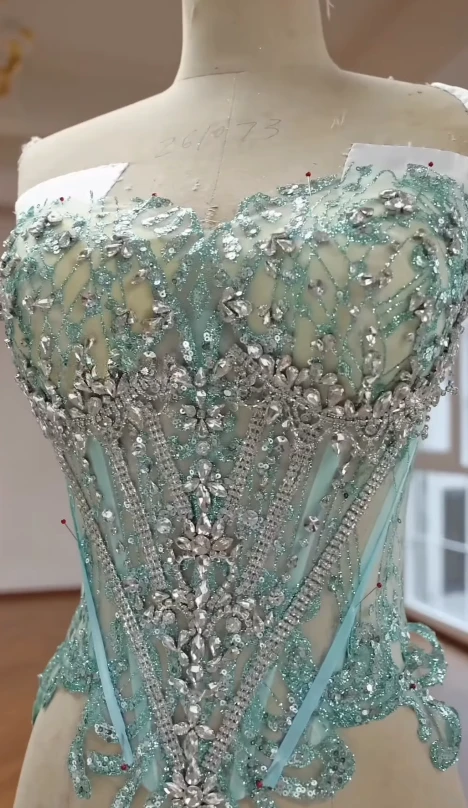
The embellishment is no longer an isolated decoration. It becomes part of how the body and gown are read together.
Vertical crystal lines draw the eye through the corset. Teardrop stones create focal points around the bust and waist, while the sequined vine pattern remains visible underneath.
That layered surface matters. If the crystals completely flattened the sequined base, the gown would lose some of the depth created by the original fabric.
One bodice detail has to make sense at full length.
Once the small decisions are complete, the gown has to work as a single silhouette rather than a collection of individual embellishment details.

The full skirt gives the crystal corset enough visual space to remain the focal point without making the entire gown feel heavy. Mint green sequined tulle carries the reflective surface downward while the satin underlayer gives the skirt body and depth.
The drama comes from controlled proportion, not from making every surface compete for attention.
A toile solves the pattern. It does not finish the fitting.
For custom orders, the construction moves through at least two fitting stages: one in the toile and another in the fashion fabric.
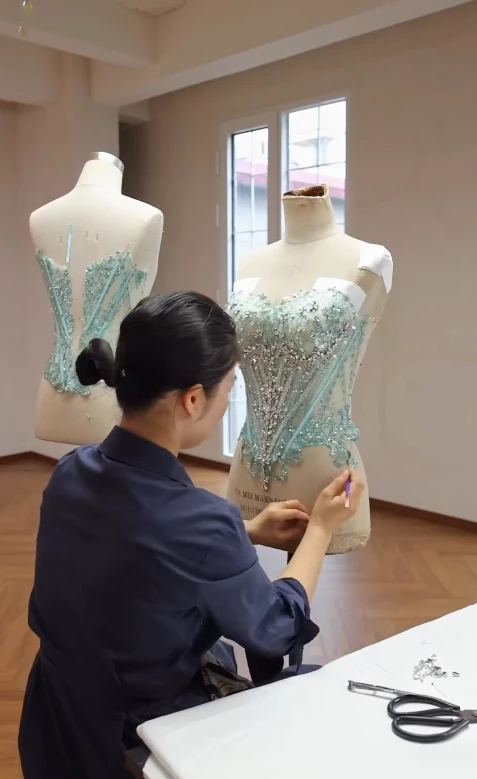
Each fitting can mean taking sections apart, adjusting the pattern or construction and rebuilding the garment. It is slower than producing a standard size, but it allows a made to order gown to respond to the actual measurements of its wearer.
Proportion is recalculated. It is not assumed.
Crystal placement changes with bust, waist and torso proportions, so the embellishment map is adjusted rather than copied identically across every size.
Every visible line has a reason.
At the final stage, the goal is not to add more decoration. It is to confirm that every element still supports the original proportion.
Craftsmanship is often hidden inside the finished photograph.
A couture level result is rarely created by one dramatic detail. It can be a decision to separate crystal chain from boning so the wearer does not feel a hard ridge. It can be hand sewing every cup individually instead of relying on glue.
It can also mean making a muslin toile before cutting the fashion fabric, recalculating crystal lengths when proportions change, or protecting sequins during pressing. None of these decisions necessarily announces itself from across the room.
The construction is what makes it work.
Questions about the construction
The most useful details are often the ones that explain why a gown is constructed a certain way.
Why isn't the crystal chain sewn directly over the corset boning?
A rigid crystal cup-chain can create a hard ridge when placed directly over plastic or steel boning. Separating the visible crystal line from the internal support allows the corset to remain structured while keeping the surface more comfortable against the body.
How is crystal embellishment attached to sequined tulle?
The crystal cup-chain is positioned first, then sewn by hand using a fine beading needle and nylon thread. Individual crystal cups are secured through the tulle so the attachment is distributed instead of depending on a single connecting point.
How long does the hand beading take?
One bodice takes roughly two full working days of hand beading, not including the initial crystal placement and layout.
Does the crystal placement change between dress sizes?
Yes. Bust to waist proportions change between sizes, so crystal segment lengths and placement points are recalculated rather than simply enlarging one fixed embellishment map.
Why is a muslin toile used before cutting the finished fabric?
The toile allows the atelier to evaluate silhouette, waist placement, skirt volume and proportions before cutting the more expensive sequined fashion fabric.
Can a heavily embellished ball gown still be comfortable for a long event?
Construction choices matter. Keeping rigid crystal chain separate from the internal boning, allowing controlled ease in the embellishment and securing individual crystal sections can reduce unnecessary stiffness while preserving the visual effect.
Explore More Behind the Making
From crystal placement and hand beading to pattern development and final fitting, explore more Kemedress atelier stories and see how custom gowns are built one decision at a time.
The Anatomy of a Garden: Inside a Flower Beaded Green Ball Gown
Follow another green ball gown from its surface design and floral beading to the detailed atelier work behind the finished silhouette.
How Kemedress Makes an Emerald Green Ball Gown
See another behind the scenes look at the construction of an emerald green ball gown and the decisions that shape its final form.
How We Make a Blush Pink Ball Gown: Step by Step
Continue through another ball gown construction record, with a closer look at the stages involved in turning fabric into a finished formal gown.
From a Single Piece of Fabric to a Custom Gown
Step back and explore the broader Kemedress making process, from the first fabric decisions through construction and finishing.
Discover more atelier stories covering custom gowns, hand embellishment, pattern development, fitting and detailed dress construction.